Space Probes

An analysis of wide binary stars shows that they're twins

An article accepted for publication in the journal “The Monthly Notices of the Royal Astronomical Society” reports a study on wide binary stars. A team of researchers led by Keith Hawkins of the University of Texas, Austin, studied 25 pairs of wide binary stars identified using data collected by ESA’s Gaia space probe. Using the Harlan J. Smith telescope at the McDonald Observatory, the researchers examined in depth the chemical composition of the 50 stars, concluding that stars born together show a practically identical chemical composition, much closer than randomly chosen stars of the same type.

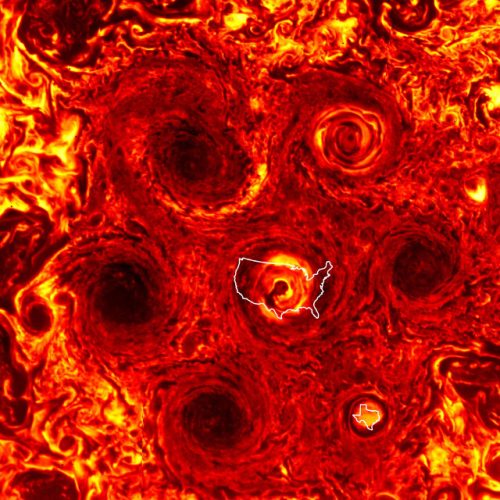
Jupiter's south pole seen by JIRAM

A new cyclone was discovered at the south pole of the planet Jupiter by NASA’s Juno space probe. In particular, it was the JIRAM instrument that captured the first images in which you can see that the configuration of the cyclones existing in that area changed from a pentagon of cyclones surrounding a central one to a hexagon, still around a central one. The new cyclone seems small compared to the ones already existing but its surface is comparable to that of Texas. This discovery was made during a Jupiter flyby that follows a maneuver needed to prevent Juno from ending up in the planet’s shadow for 12 hours. Without being powered by solar panels, its batteries would have completely drained and its temperature would have dropped to lethal levels.

Slowing of the solar wind in the outer solar system

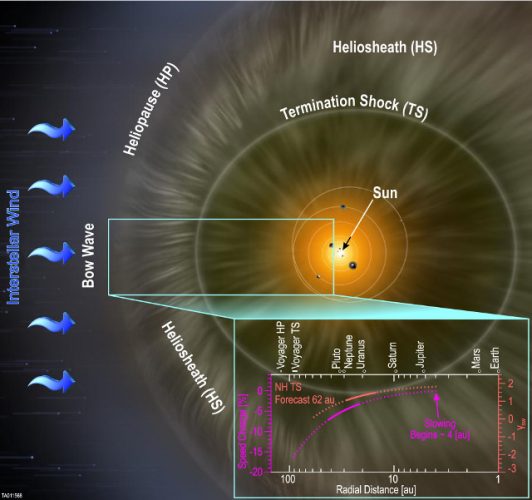
An article published in “The Astrophysical Journal” reports a study on changes in the solar wind in the outer region of the heliosphere, the bubble in which the influence of the Sun is felt. A team of researchers from the Southwest Research Institute led by Dr. Heather Elliott used measurements collected by NASA’s New Horizons space probe’s Solar Wind Around Pluto (SWAP) instrument to compare the speed of the solar wind at distances from the Sun between 1 and 3 times that of the Earth from the Sun and at distances between 21 and 43 times that distance reveals a slowdown between 5% and 7% at distances between 30 and 43 times that of the Earth from the Sun.

Remains of glaciers that sculpted the territory of Deuteronilus Mensae on Mars

ESA has published new images of the region of the planet Mars called Deuteronilus Mensae captured by its Mars Express space probe’s High Resolution Stereo Camera (HRSC) instrument that show a territory sculpted by the movements of glaciers that created formations such as those known as mesas. That’s a particularly interesting region because already in the last decade traces of ice still there were discovered. In the past, there was perhaps a regional ice cap in that area of ​​which Deuteronilus Mensae represents the remains.

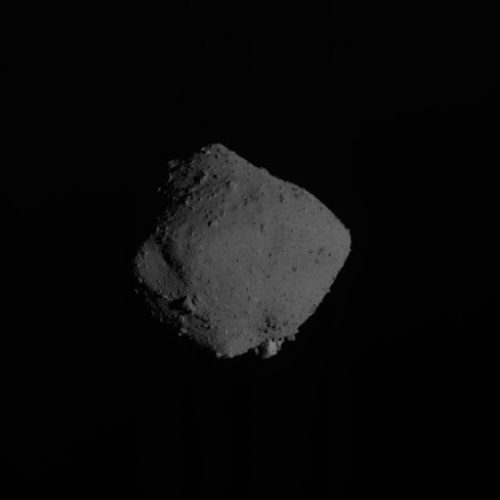
Asteroid Ryugu (Photo courtesy JAXA, Chiba Institute of Technology, University of Tokyo, Kochi University, Rikkyo University, Nagoya University, Meiji University, University of Aizu, AIST)

The Japanese space agency JAXA has confirmed that its Hayabusa 2 space probe has left asteroid Ryugu, reached on June 27, 2018. Until November 19 it will keep on taking pictures of Ryugu, a limit due to the fact that subsequently a maneuver needed to use its ion engine will lead it to turn into a position from which it will no longer have the asteroid in its camera’s view. Until that day, it will be possible to send a farewell message to Ryugu via Twitter or even letters and postcards to JAXA. Hayabusa 2 is scheduled to return near the Earth with its samples near the end of 2020.