Space Probes

The differences between the two faces of the Moon could be due to the impact of a dwarf planet

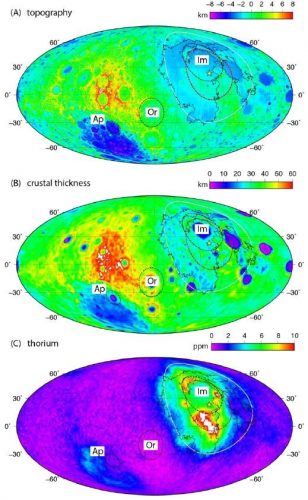
An article published in the “Journal of Geophysical Research: Planets” reports the results of computer simulations generated to explain the asymmetry of the two faces of the Moon. A team of researchers used data from NASA’s GRAIL mission as a reference to try to reproduce the Moon’s situation, concluding that the best explanation comes from the simulation of the impact of a dwarf planet with a diameter of about 780 kilometers on the current Earth-facing Moon’s side at about 22,500 km/h.

A possible underground ocean on Pluto could be protected by an insulating layer

An article published in the journal “Nature Geoscience” reports the results of a study of the conditions that could allow the presence of an ocean below the dwarf planet Pluto’s surface. A team of researchers analyzed using computer simulations the possibility that under the heart-shaped area called Sputnik Planitia there’s a layer of gas hydrate of the class known as clathrates formed by water and natural gas which acts as an insulator allowing the layer below them it remains warm enough to keep water in its liquid state.

Ultima Thule image on the cover of Science (Image NASA/Johns Hopkins University Applied Physics Laboratory/Southwest Research Institute/Roman Tkachenko)

An article published in the journal “Science” reports the initial results of the exploration of the Kuiper Belt Object 2014 MU69 nicknamed Ultima Thule by NASA’s New Horizons space probe. There are no particular surprises after the ones arrived thanks to the first images sent to the Earth but the following high-resolution ones along with spectrometric data and other data sent allowed to put together some more details about its characteristics from the mission team.

There may still be tectonic activity on the Moon

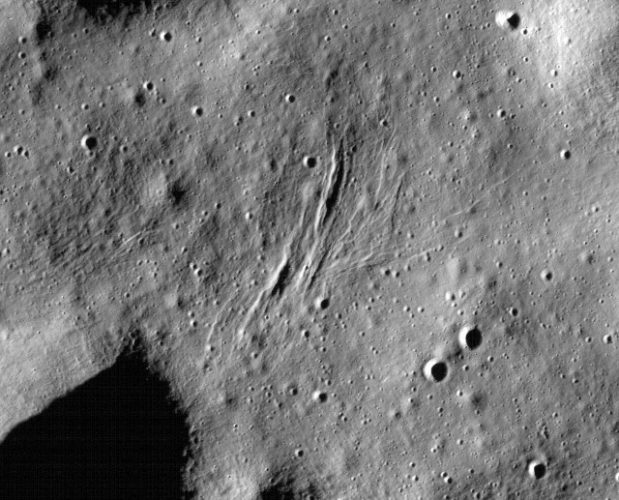
An article published in the journal “Nature Geoscience” offers clues to the fact that the Moon may still be tectonically active. A team of researchers analyzed images captured by NASA’s Lunar Reconnaissance Orbiter (LRO) space probe in 2010 discovering thousands of tectonic faults generated by the Moon’s progressive shrinking as it cooled down. Some researchers have been working on these geological analyzes since those photos were taken but initially they brought clues about a recent activity while the new clues indicate that an activity still exists.

A measurement of the temperatures on the surface of comet 67P/Churyumov-Gerasimenko

An article published in the journal “Nature Astronomy” reports a series of measurements of the temperature of comet 67P/Churyumov-Gerasimenko’s nucleus obtained thanks to ESA’s Rosetta space probe’s VIRTIS instrument. A team of researchers led by Federico Tosi of the National Institute of Astrophysics’ Space Astrophysics and Planetology Institute in Rome, Italy, used the infrared images captured by VIRTIS to generate thermal maps from which they obtained the temperatures reconstructing the daily and seasonal variations but also the ones related to its morphological characteristics and the chemical-physical characteristics of the top surface layer.