
Space Probes

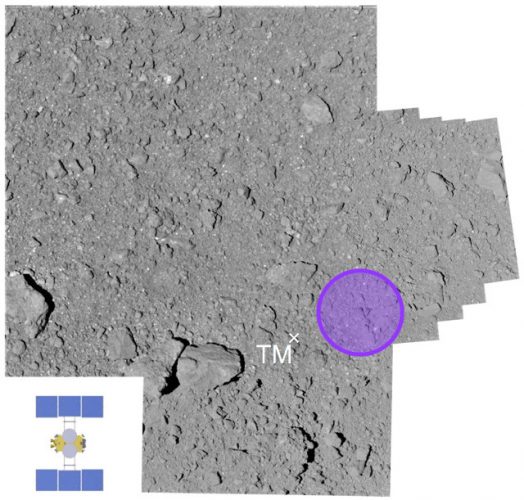
The L08-E1 area on asteroid Ryugu touched by Hayabusa 2 (Image courtesy JAXA)

A few hours ago, the Japanese space probe Hayabusa 2 touched down on the soil of asteroid Ryugu to collect some samples of regolith, the soil’s surface layer, which will be transported back to Earth. This is the first of the three possible attempts and now the Japanese space agency JAXA will have to assess whether to look for another area on the asteroid and proceed with a second attempt.

The deep fractures on the surface of comet 67P/Churyumov-Gerasimenko were generated by shear stress

An article published in the journal “Nature Geoscience” shows an analysis of the erosion processes that have generated deep fractures and faults in the nucleus of comet 67P/Churyumov-Gerasimenko. A team of researchers led by geologist Christophe Matonti of the Aix-Marseille University, France, examined images captured by ESA’s Rosetta space probe’s OSIRIS camera to perform a geological and morphological analysis identifying two fracture formation processes. According to the researchers, surface fractures are generated by temperature changes while the deeper fractures are generated by shear stress.

The starts that form the cosmic river in red with a Gaia map in the background (Image Meingast et al / Gaia DR2 skymap)

An article published in the journal “Astronomy & Astrophysics” reports the discovery of what was called a river of stars, a stream of stars a little over 300 light years away from us that occupies most of the southern sky. Astronomers of the University of Vienna used information collected by ESA’s Gaia space probe and published in the so-called Data Release 2 (DR2) to discover at least 4,000 stars that have been moving together in space since their formation, which was about a billion years ago.

Ultima Thule has a shape even stranger than expected

NASA and the Johns Hopkins University Applied Physics Laboratory have published new images of the Kuiper belt Object cataloged as 2014 MU69 and nicknamed Ultima Thule along with animations that show new details of its shape. A sequence of 14 images captured by the New Horizons space probe during its January 1, 2019 flyby shows that the this object’s two lobes are not vaguely spherical as it seemed but in particular the larger one is definitely flat, to the point that it was compared to a pancake, and it’s not clear why it has that shape.

Some details on the geology of Ultima Thule

The Johns Hopkins University Applied Physics Laboratory, which collaborates with NASA at the New Horizons mission, has published a new image of the Kuiper Belt Object cataloged as 2014 MU69 and nicknamed Ultima Thule which offers more details of its geological features. Various pits, the great depression on the smallest lobe, the “collar” that joins the two lobes, clear and dark features will be studied to get answers to the many questions posed after receiving the first images taken by the space probe in its New Year’s Day 2019 flyby.