Space Probes

Close-up of Saturn's rings (Image NASA/JPL-Caltech/Space Science Institute)

An article published in “The Astrophysical Journal” reports a precise measurement of the duration of the day on the planet Saturn. The lack of a solid surface with reference points and a magnetic field with unusual characteristics prevented precise measurements, but now a team of researchers led by Christopher Mankovich of the University of California, Santa Cruz, (UCSC) accomplished that feat by exploiting data collected by the Cassini space probe on the effects that the vibrations inside Saturn cause on the oscillation of its gravitational field and consequently also on the rings. The result is that the day on the planet was measured in 10 hours, 33 minutes and 38 seconds.

Evidence of methane rains on Saturn's great moon Titan's north pole

An article published in the journal “Geophysical Research Letters” reports evidence of rainfall on Titan, the largest of Saturn’s moons. A team of researchers led by Rajani Dhingra, a doctoral student in physics at the University of Idaho, examined images captured by the Cassini space probe, finding an anomaly at the north pole of Titan interpreted as a methane rain. This is an indication of the beginning of summer in this moon’s northern hemisphere.

New estimates of Saturn's characteristics include the age of its rings

An article published in the journal “Science” describes a research on the planet Saturn that includes an analysis of its internal structure but also on its evolution, which includes its rings’. A team of researchers led by Luciano Iess of the Sapienza University of Rome, Italy, used data collected by the Cassini space probe to determine that the winds on Saturn reach a depth of about 9,000 kilometers and that the rings were formed not more than 100 million years ago.

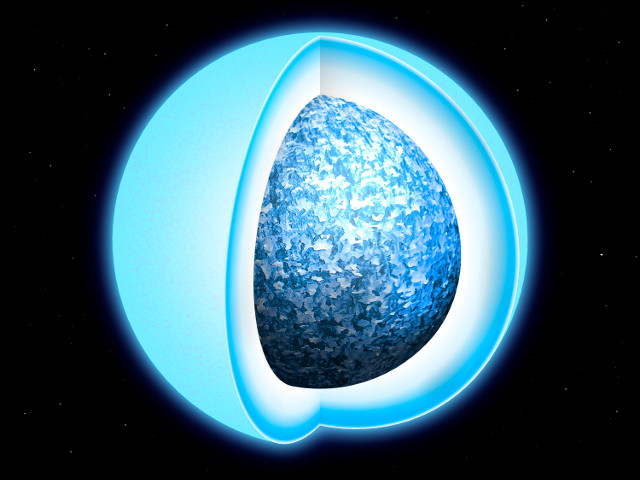
Artist’s impression of crystallisation in white dwarf (Image courtesy University of Warwick/Mark Garlick. All rights reserved)

An article published in “Nature” shows the evidence that in white dwarfs oxygen and carbon slowly crystallize from their cores. A team of researchers used data collected by ESA’s Gaia space probe that include distance, brightness and color of hundreds of thousands of white dwarfs analyzing over 15,000 candidates within 300 light years away from Earth to collect evidence of the crystallization process. This is the first verification of a prediction dating back to the beginning of the 1960s.

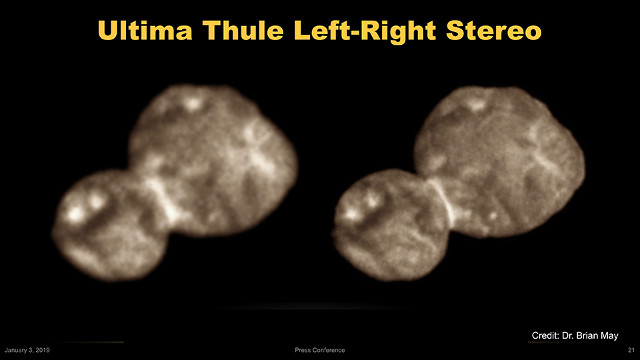
Ultima Thule offers the first answers but leaves many questions open

In a press briefing that included a number of scientists working on NASA’s New Horizons mission, the first discoveries on the Kuiper Belt object cataloged as 2014 MU69 and nicknamed Ultima Thule were presented, obtained thanks to data received during the January 1, 2019 flyby. They’re based on information that’s still incomplete, which could be contradicted by high resolution photos and other data but for the moment this object doesn’t appear to have neither moons nor rings, or at least not of relevant sizes, no impact craters were found on its surface nor were traces of atmosphere.