
Space Probes

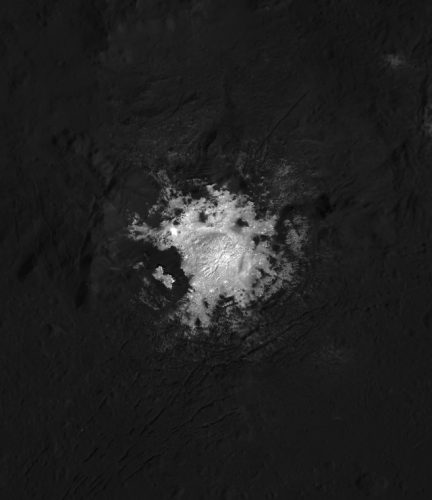
Cerealia Facula in Occator Crater (Image NASA/JPL-Caltech/UCLA/MPS/DLR/IDA)

At the Committee on SPAce Research (COSPAR) meeting held this week in Pasadena, NASA’s JPL scientists are presenting the latest information gathered by NASA’s Dawn space probe about the dwarf planet Ceres. In particular, there’s an attention on Occator Crater, the most famous crater thanks to its brightness due to the various bright spots made of salts inside it, now called faculae. In the next few months Dawn will finish its mission but will continue to collect data from the lowest orbit at only 34-35 kilometers (about 21 miles) of altitude.

Scheme of Hubble and Gaia at work (Image NASA, ESA, and A. Feild (STScI))

An article published in the journal “The Astrophysical Journal” describes a new measurement of the expansion of the universe. A team of astronomers led by Nobel Prize winner Adam Riess combined observations made with the Hubble Space Telescope and those made with ESA’s Gaia space probe, an observatory that specifically aims to map billions of objects in the sky including the variable stars called Cepheid variable used for those measurements. The new results increase the accuracy but also the discrepancy between the measures of the expansion of the near universe and those of the early universe.

Artitst's concept of Enceladus and Saturn (Image NASA/JPL-Caltech)

Two articles published in the journal “Geophysical Research Letters” describe studies concerning the planet Saturn’s system based on information obtained from the Cassini space probe during what was called the Grand Finale, the orbits close to Saturn performed in the weeks preceding the end of that extraordinary mission. In particular, the audio was generated that contains sound obtained by converting the electromagnetic emissions discovered between Saturn and its rings and Enceladus generated by movements of plasma between them.

Jupiter and its aurora

An article published in the journal “Science” describes a research on the influence shown on the aurorae at Jupiter’s poles by its moons Io and Ganymede. A team led by Alessandro Mura of the National Institute for Astrophysics in Rome, Italy, analyzed data collected in particular from the NASA’s Juno space probe’s JIRAM instrument, discovering that Io leaves a series of long traces in Jupiter’s aurorae while Ganymede leaves a double “shadow” in them.

Asteroid Ryugu

The Japanese space agency JAXA has confirmed that its space probe Hayabusa 2 has reached the asteroid Ryugu. It’s now at an altitude of about 20 kilometers and from there it will begin a series of observations of the surface in order to find the most suitable area to land. That maneuver will take place in October 2018 at a date yet to be determined.