Space Probes

Artist's concept of New Horizon's Ultuma Thule flyby (Image NASA/JHUAPL/SwRI/Steve Gribben)

NASA has announced that it chose Ultima Thule as a nickname for 2014 MU69, the Kuiper Belt Object that represents the next target for its New Horizons space probe. In recent months, the mission team asked for suggestions on the Internet and then opened a ballot allowing to select the favorite among the nicknames selected among the thousands of proposals. The result is not an official name, which must be ratified by the International Astronomical Union (IAU), because it’s not clear if Ultima Thule is a single object.

Cyclones at Jupiter's north pole (Image NASA/JPL-Caltech/SwRI/ASI/INAF/JIRAM)

Four articles published in the journal “Nature” describe as many researches on the planet Jupiter. Different teams of researchers focused on different phenomena using data collected by NASA’s Juno space probe. The researches concerns groups of huge cyclones present in Jupiter’s polar regions, wind flows that extend up to thousands of kilometers of depth, the stripes of the atmosphere that rotate at different speeds and the asymmetries in the planet’s gravitational field.

The comet 67P/Churyumov-Gerasimenko on August 6, 2014 (Image ESA/Rosetta/MPS for OSIRIS Team MPS/UPD/LAM/IAA/SSO/INTA/UPM/DASP/IDA)

An article published in the journal “Nature Astronomy” describes a research that offers new clues about the comet 67P/Churyumov-Gerasimenko’s formation. A team led by Stephen Schwartz of the University of Côte d’Azur and the University of Arizona conducted a series of computer simulations to study the formation of comets like this one, formed by two lobes, expanding previous studies confirming them and offering an explanation to some of its characteristics.

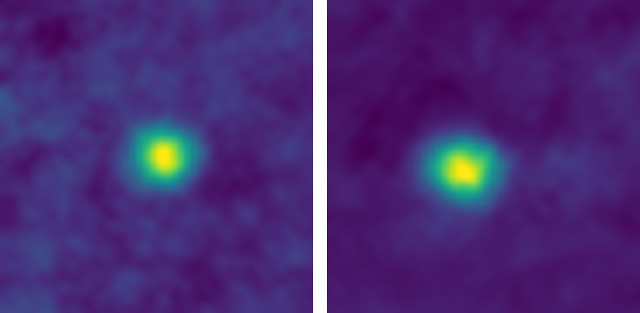
False-color photo of 2012 HZ84 and 2012 HE85 (Image NASA/JHUAPL/SwRI)

NASA has published some photos taken by its New Horizons space probe’s LORRI instrument in December 2017. During the course of its journey that will lead to the object called 2014 MU69’s flyby, New Horizons took photos that beat the record that belonged to Voyager 1 for the farthest photo ever taken from Earth capturing images of the open stellar cluster called Wishing Well and two Kuiper Belt Objects called 2012 HZ84 and 2012 HE85.

Underground ice exposed at the steep slope that appears bright blue in this enhanced-color view (Image NASA/JPL-Caltech/UA/USGS)

An article published in the journal “Science” describes the discovery of eight areas on the planet Mars where soil erosion revealed the presence of large glaciers. A team of researchers located and studied the areas thanks to NASA’s Mars Reconnaissance Orbiter (MRO) space probe’s High Resolution Imaging Science Experiment (HiRISE) camera. The slopes generated by erosion offer new information on those glaciers’ stratified structure and consequently on the red planet’s climate history.