Space Probes

Scheme of Enceladus interior (Image Surface: NASA/JPL-Caltech/Space Science Institute; interior: LPG-CNRS/U. Nantes/U. Angers. Graphic composition: ESA)

An article published in the journal “Nature Astronomy” describes a research that presents a possible explanation for the long-term existence of hydrothermal activities and an underground ocean of liquid water on Enceladus, one of Saturn’s moons. A team of researchers led by Gaël Choblet of the University of Nantes in France analyzed data collected by the Cassini space probe concluding that a porous core can be a key factor in generating heat for billions of years supporting an environment potentially favorable to life.

Aurora at Jupiter's North Pole (Image NASA / ESA / J. Nichols (University of Leicester))

An article published in the journal “Nature Astronomy” describes a research on the auroras on the planet Jupiter. A team of researchers used ESA’s XMM-Newton and NASA’s Chandra space telescopes to observe the pulsations of Jovian auroras. The study shows that the auroras pulsate independently at the two poles, unlike what happens on Earth.

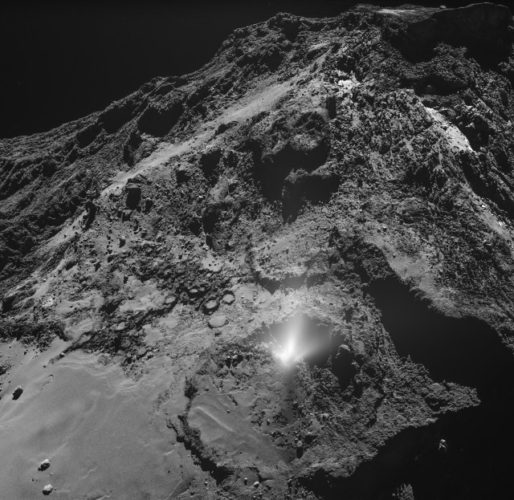
Plume on comet 67P/Churyumov-Gerasimenko (Image ESA/Rosetta/MPS for OSIRIS Team MPS/UPD/LAM/IAA/SSO/INTA/UPM/DASP/IDA)

Two articles published in the journal “Monthly Notices of the Royal Astronomical Society” describe two researches on comet 67P/Churyumov-Gerasimenko based on data collected by ESA’s Rosetta space probe. In an article, a team led by Jürgen Blum of the Technische Universität Braunschweig, Germany, used the data collected to find out how the comet formed. In the other article, a team led by Jessica Agarwal of the Max Planck Institute for Solar System Research in Göttingen, Germany, described a plume on the surface of the comet that could have been generated by pressurized underground gas or by the crystallization of amorphous water ice.

Artist's concept of Mars' magnetic tail (Image Anil Rao/Univ. of Colorado/MAVEN/NASA GSFC)

During the 49th annual meeting of the American Astronomical Society’s Division for Planetary Sciences, the results were presented of a research that led to the discovery that the planet Mars has a magnetic tail, called magnetotail, twisted by the interaction with the solar wind. A team led by Dr. Gina DiBraccio of NASA’s Goddard Space Flight Center used data from the MAVEN space probe to discover this phenomenon that according to the researchers is linked to the process known as magnetic reconnection.

The Ernutet crater and the organic materials (Image NASA/JPL-Caltech/UCLA/ASI/INAF/MPS/DLR/IDA)

In the course of the Conference of the American Astronomical Society’s 49th Division for Planetary Sciences Meeting, SwRI (Southwest Research Institute) scientist Simone Marchi presented the results of a study on the origin of the organic compounds discovered on the dwarf planet Ceres by NASA’s Dawn space probe. There were some doubts about the possibility they had formed on Ceres but according to Marchi and his team the evidence they collected that’s the most likely theory.