Space Probes

An image of the asteroid Dimorphos (a) with a magnified area (b) that was analyzed in one of the articles and a mapping of the fractures of the boulders (c)

Five articles published in the journal “Nature Communications” report different analyses of data collected by NASA’s DART spacecraft and the Italian Space Agency’s LICIACube nanosatellite that accompanied it on its mission that ended with the collision with Dimorphos, a small satellite asteroid of Didymos, which occurred on September 26, 2022. Various teams of researchers with members in common offered possible reconstructions of the processes that led to the formation of the pair of asteroids and their characteristics. These studies are connected to the defense of the Earth from asteroid impacts.

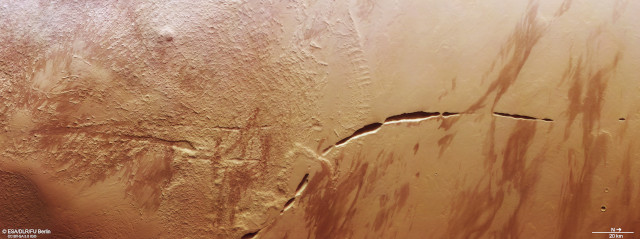
Aganippe Fossa

ESA has published an image captured by its Mars Express space probe’s High Resolution Stereo Camera (HRSC) instrument of Aganippe Fossa, a formation that has the appearance of a scar on the surface of the planet Mars which is truly colossal given that it’s approximately 600 kilometers long. This rift valley is a geological formation of the type called graben in jargon. There are no certainties about its formation but it’s probably linked to lava flows under the enormous volcanoes of the Tharsis region, starting with Arsia Mons, the closest to Aganippe Fossa.

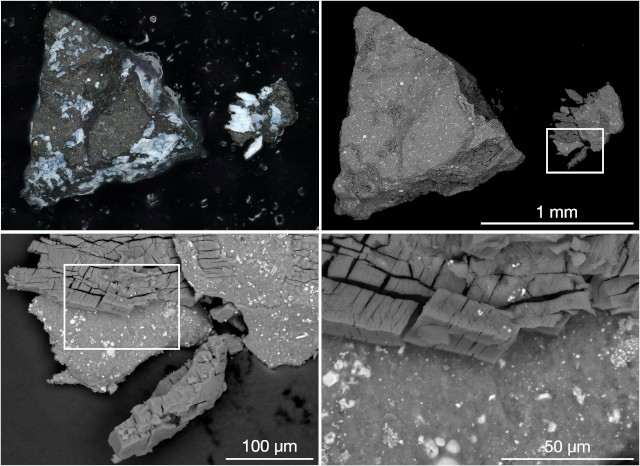
At the top left a sample taken from the asteroid Bennu and in the subsequent panels increasingly zoomed views of a fragment that broke off along a bright vein that contains phosphate, captured under an electron microscope

An article published in the journal “Meteoritics & Planetary Science” reports the results of the preliminary analysis of the samples of material from asteroid Bennu brought back to Earth by NASA’s OSIRIS-REx space probe. A team of researchers conducted morphological and chemical analyzes of the samples, finding a lot of carbon and nitrogen together with organic compounds, all very important components for life forms of the Earth’s type.

The surprise came from the discovery of magnesium-sodium phosphate, which wasn’t detected by the instruments aboard OSIRIS-REx. This compound forms in water-rich environments and suggests that Bennu may be a fragment of a primordial world that had an ocean. The researchers mentioned Enceladus, Saturn’s moon with a subterranean ocean where sodium phosphate was found, and suggest a possible link to Bennu.

The Ceraunius Tholus volcano as seen by the TGO space probe's CaSSIS instrument with the frost in blueish

An article published in the journal “Nature Geoscience” reports the detection of frost on volcanoes in the Tharsis region on Mars. A team of researchers used data obtained from two ESA space probes, the ExoMars mission’s TGO and Mars Express, which made it possible to discover for the first time the presence of frozen water on the Martian surface at the red planet’s equator. In the calderas of the big volcanoes of Tharsis, blue deposits that can be attributed to water ice were spotted which are present only in the morning and then evaporate a few hours later.

Magnetite particles cut from an asteroid Ryugu's sample

An article published in the journal “Nature Communications” reports the results of tests conducted on samples from the asteroid Ryugu brought back to Earth by the Japanese space agency JAXA’s Hayabusa 2 space probe. A team of researchers led by Professor Yuki Kimura of Hokkaido University found traces of the effects probably caused by the bombardment of micrometeorites.

In particular, the technique called electron holography made it possible to discover that the tiny grains called framboids, composed of magnetite, completely lost the magnetic properties they normally have. According to Professor Kimura, this type of study can also be useful for estimating the degradation caused by interplanetary dust on spacecraft.