Space Probes

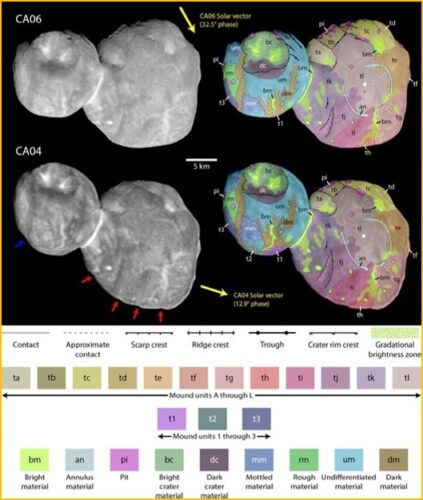
A mosaic of photos of Arrokoth taken by the New Horizons space probe's LORRI instrument on the left and a geologic map of the asteroid on the right

An article published in the journal “The Planetary Science Journal” reports a study on the mound-like formations found on asteroid Arrokoth by NASA’s New Horizons space probe. The images collected show that especially the largest lobe, which was named Wenu, is dominated by these geological features but the smaller lobe, which was named Weeyo, has some of them as well. A team of researchers led by Alan Stern conducted simulations that indicate that these are the traces of smaller bodies that coalesced in the very early history of the solar system. This offers new insights into the formation mechanisms not only of asteroids but also of larger rocky bodies.

The capsule containting asteroid Bennu's samples (Image NASA TV)

A little while ago, the samples taken from the asteroid Bennu brought back to Earth by NASA’s OSIRIS-REx space probe were collected by the American space agency’s crew in the area of their landing, at the Utah Test and Training Range. They will be transported to the Johnson Space Center, the first stage of a series of operations needed to process them while avoiding their contamination. In this study, NASA is collaborating with the Japanese space agency JAXA, which will receive some of the samples to compare them with those collected by its own Hayabusa 2 space probe on the asteroid Ryugu and returned to Earth in December 2020.

The Aditya-L1 space probe at blastoff (Image courtesy ISRO)

A few hours ago, the Indian space probe Aditya-L1 blasted off from the Satish Dhawan space center atop a PSLV-XL rocket. After about ten minutes, it regularly separated from the rocket’s last stage. In about 109 days, Aditya-L1 will reach the Lagrange point called L1, about 1.5 million kilometers from the Earth, where it will begin its mission of observing the solar atmosphere and various processes taking place on the Sun’s surface. It will join other space probes and solar observatories helping to unlock the last secrets of the Sun.

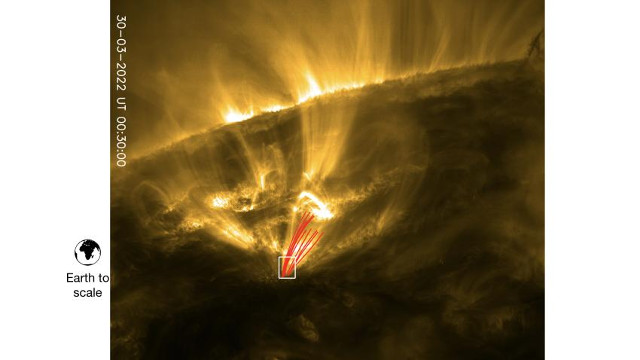
A partial section of the Sun photographed by the Solar Orbiter space probe's EUV instrument with gas at a temperature of around one million degrees Celsius

An article being published in the journal “Astronomy & Astrophysics” reports a study of what were compared to shooting stars, observed in details never obtained before together with the solar corona. A team of researchers coordinated by Northumbria University in Newcastle used observations conducted by ESA’s Solar Orbiter space probe to study what are actually clumps of plasma that can be up to 250 kilometers wide, a coronal rain that falls on the surface of the Sun. That plasma heats up to a few million degrees, a state that lasts a few minutes during the fall until it condenses following its quick drop in temperature.

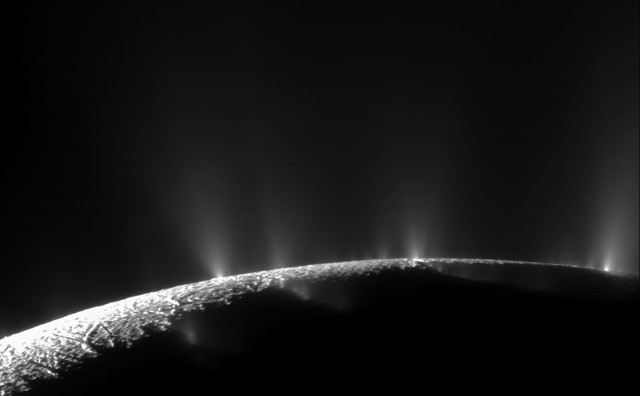
Enceladus and some of its geysers (Image NASA/JPL/Space Science Institute)

An article published in the journal “Nature” reports the discovery of phosphorus, a key element for many biological processes, on Enceladus, the moon of the planet Saturn which has an underground ocean of liquid water. A team of researchers led by Frank Postberg of the Freie Universität Berlin, Germany, analyzed data collected by the Cassini space probe made available in the Planetary Data System and in particular the data detected by the Cosmic Dust Analyzer instrument in samples of icy particles emitted by the geysers of Enceladus that arrived in one of Saturn’s rings.

The result of the analysis was the discovery of phosphates in concentrations at least one hundred times higher than those of the Earth’s oceans. Geochemical models suggest that phosphorus may be present in subsurface oceans of other moons. These discoveries increase the probability that life forms have arisen in the subsurface of some of those moons.