Space Probes

Artistic representation of the Voyager 1 space probe in deep space (Image NASA/JPL-Caltech)

An article published in “Astrophysical Journal Letters” describes a new analysis of the data collected by NASA’s Voyager 1 space probe to understand why certain detections were abnormal. Voyager 1 entered interstellar space in 2012 but the unclear data raised discussions. After about a year, NASA confirmed the event but some unexpected characteristics of the solar system borders required further studies.

The comet 67P/Churyumov-Gerasimenko on October 18, 2015 (Photo ESA/Rosetta/NavCam)

An article just published in the journal “Nature” describes the discovery of oxygen molecules in the coma of the comet 67P/Churyumov-Gerasimenko. It’s a surprising discovery, and in fact is the first time that this presence is detected in a comet because molecular oxygen is very reactive so it tends to combine for example with hydrogen to form water. This oxygen is a “survivor” from the time of formation of the solar system.

Picture of Mangala Valles on Mars taken by ESA's Mars Express space probe (Photo ESA/DLR/FU Berlin)

The analysis of photographs of the region of Mars known as Mangala Valles led to the conclusion that it was volcanic activity that generated the heat that caused catastrophic floods through the melting of glaciers. The photographs were taken by ESA’s Mars Express space probe on July 12, 2015 just south of the valley known as Minio Vallis, a part of the canal system of Mangala Valles, near the equator in the western hemisphere of the red planet.

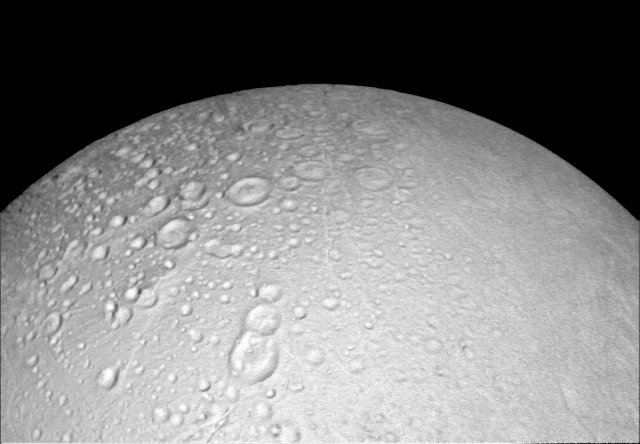
The area around Enceladus north pole with its many craters photographed by the Cassini space probe (Photo NASA/JPL-Caltech/Space Science Institute)

In recent days, the Cassini spacecraft made one of the closesest flybys with Enceladus, one of Saturn’s moons, passing at a distance of about 1,840 kilometers (almost 1,140 miles) from its surface. The first pictures received at the mission control center show that Enceladus north pole has many fractures in the ice crust that covers this moon but there are also thin cracks running through it and many craters around it.

High-resolution picture of Pluto. In the upper right a part of the heart-shaped area (Photo NASA/JHUAPL/SwRI)

The journal “Science” just published the first article on the findings on the dwarf planet Pluto and its moons made thanks to NASA’s New Horizons spacecraft July 14, 2015 flyby. Alan Stern of the Southwest Research Institute (SwRI), the principal investigator of the New Horizons mission, is also the first of a long series of authors of this study that first of all stresses the extraordinary geological and morphological variety of Pluto’s system.