Space Probes

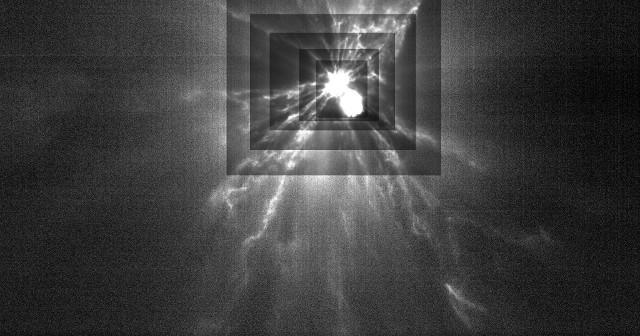
Asteroid Dimorphos and the ejected materials seen by LICIACube (Image ASI/NASA/APL)

In a press conference, NASA confirmed the success of its DART mission after ascertaining that the orbit of asteroid Dimorphos was changed by the impact of the spacecraft. According to calculations, Dimorphos now orbits the asteroid Didymos in 11 hours and 23 minutes while before the impact, it took 11 hours and 55 minutes for each orbit. The margin of error is approximately 2 minutes, which indicates that the success is far greater than the minimum predicted. The monitoring will continue, especially by the LICIACube mini-probe, to obtain more precise data, also on the materials ejected after the impact, as their characteristics will help to understand the composition of Dimorphos.

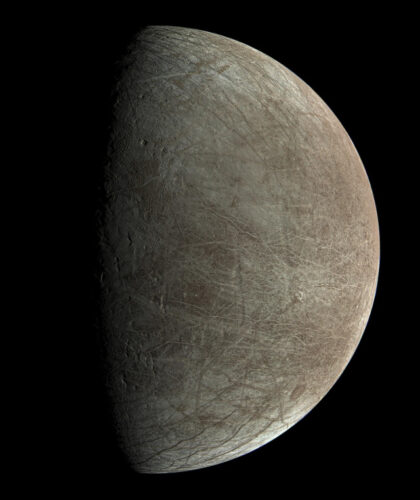
Europa seen by the Juno space probe (Image data: NASA/JPL-Caltech/SwRI/MSSSImage processing by Björn Jónsson)

NASA has released images of Europa, one of Jupiter’s so-called Galilean satellites, captured by its Juno space probe during a flyby conducted on September 29. The JunoCam was the main instrument for this task but for the occasion, a close-up shot was also captured by the SRU (Stellar Reference Unit), an instrument generally used to orient Juno by observing the stars. The photos taken by JunoCam were processed by some of the so-called citizen scientists, amateurs who contribute following their personal passion.

A topographic map of Ultimi Scopuli's area on Mars

An article published in the journal “Nature Communications” offers new confirmation of the presence of very salty liquid water on Mars underground. A team of researchers led by Roberto Orosei of the Italian National Institute of Astrophysics and Elena Pettinelli of the Italian Roma Tre University examined detections conducted with ESA’s Mars Express space probe’s MARSIS instrument together with laboratory experiments and simulations to rule out that the data collected were generated by materials other than salty liquid water.

The asteroid Dimorphos a few seconds before the impact (Image NASA TV)

Yesterday, NASA’s DART spacecraft crashed into Dimorphos, a small asteroid satellite of Didymos, a larger asteroid. These two asteroids are visible from Earth using instruments powerful enough, which will be used to monitor Dimorphos’ orbit and how much it was modified by the impact. Nearby is LICIACube, a CubeSat-class mini-probe equipped with two cameras that will provide much better observations than any telescope on Earth.

The Sun as seen by the Solar Orbiter space probe on March 25, 2022

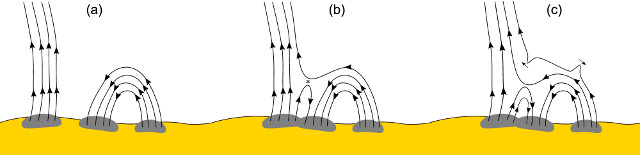
An article published in “The Astrophysical Journal Letters” offers a solution to the mystery of the local magnetic field inversion in the solar atmosphere, called switchback in jargon, observed in recent decades. A team of researchers with an important participation from the Italian National Institute of Astrophysics used detection conducted with the Solar Orbiter space probe’s METIS instrument to test the theories produced over the years.