Telescopes

The Sombrero Galaxy

An article published in “The Astrophysical Journal” reports a study on the Sombrero Galaxy and in particular on its halo. A team of researchers used the Hubble space telescope, finding a surprising abundance of stars rich in heavy elements, and computer simulations to try to understand the origin of this galaxy difficult to catalog because it’s a hybrid between the elliptical and the spiral shapes. The conclusion is that its growth occurred from the merging of two or perhaps even more massive galaxies in a chaotic process.

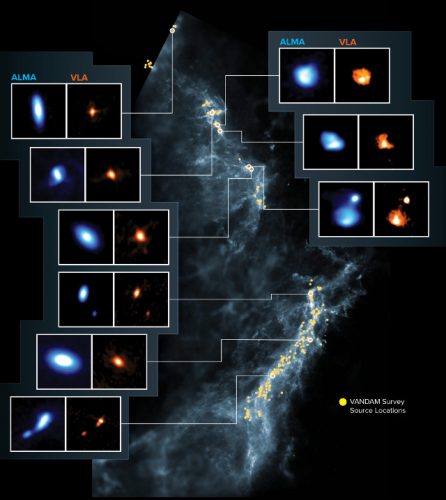
Protostars in the Orion Complex

Two articles published in “The Astrophysical Journal” report the study of a total of over 300 protostars with their protoplanetary disks in the Orion Complex, a group of molecular clouds that are perfect nurseries for the birth of new stars. A team of researchers led by John Tobin of the National Radio Astronomy Observatory (NRAO) used the data collected by the VLA and ALMA radio telescopes during the VLA/ALMA Nascent Disk and Multiplicity (VANDAM) survey to identify the four youngest protostars in the Orion Complex. A team expanded with the addition of other researchers investigated 328 protostars identified in those molecular clouds.

Artist's concept of hot Jupiter close to its star (Image courtesy University of Warwick/Mark Garlick)

An article published in the journal “Monthly Notices of the Royal Astronomical Society” reports a study on the exoplanet NGTS-10b, an ultra-hot Jupiter whose year lasts only about 18 hours. A team of researchers led by Dr James McCormac of the British University of Warwick used data collected during the NGTS survey to identify NGTS-10b thanks to its transits in front of its star. It’s the hot or ultra-hot Jupiter closest to its star observed so far, so close to it that in the distant future it could approach the point of being destroyed. This makes it an interesting object of study, also because observations conducted for several years will measure its orbit’s changes to understand if it’s really doomed.

Titan (NASA/JPL-Caltech/Space Science Institute)

An article published in “The Astrophysical Journal” reports a study of the chemical compounds in the atmosphere of Titan, Saturn’s great moon. Takahiro Iino of the University of Tokyo, together with Hideo Sagawa of Kyoto Sangyo University and Takashi Tsukagoshi of NRAO (National Astronomical Observatory of Japan) used the ALMA radio telescope to detect the chemical signatures of the compounds existing on Titan discovering that of acetonitrile, including a rare isotopomer that contains nitrogen-15.

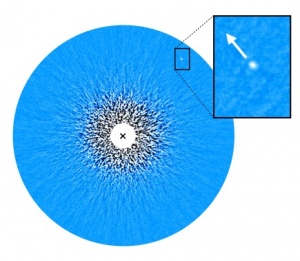
The brown dwarf GJ 504 B's system

An article published in “The Astronomical Journal” offers an explanation of the formation mechanisms of gas giant planets and brown dwarfs bringing evidence that these are two different mechanisms. A team of astronomers led by Brendan Bowler of the University of Texas, Austin, conducted observations at the Keck Observatory and with the Subaru Telescope, both in Hawaii, accompanied by computer simulations using the free / open source orbitize! software to try to understand if there were orbital differences that indicated a different origin between these objects. Their conclusion is that brown dwarfs have significantly more elliptical orbits.