Telescopes

The star GJ 1061 (Image courtesy Centre de Données astronomiques de Strasbourg / SIMBAD / SDSS)

An article being published in the journal “Monthly Notices of the Royal Astronomical Society” reports the discovery of three super-Earths in the system of the red dwarf star GJ 1061. A team of astronomers from the Red Dots collaboration made this discovery during the 2018 observation campaign thanks to a series of spectroscopic detections obtained over three months using the radial velocity method. The masses of these exoplanets are a bit higher than the Earth’s and the outermost is in ​​its system’s habitable zone, where it receives an amount of energy from its star close to what the Earth receives from the Sun.

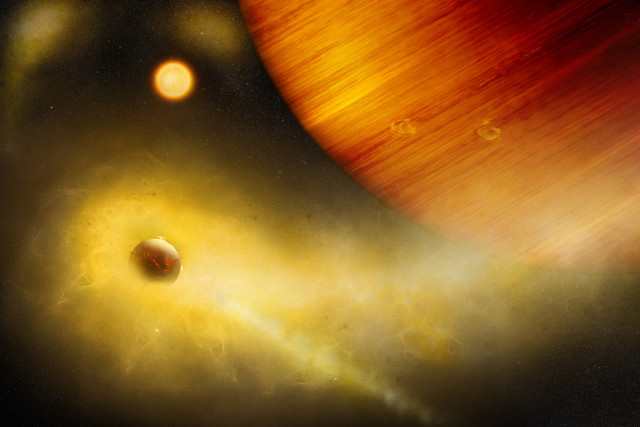
Artist's concept of an exo-Io orbiting a hot Jupiter (Image courtesy University of Bern. Illustration Thibaut Roger)

An article accepted for publication in “The Astrophysical Journal” reports on traces of sodium and potassium in the orbit of the gas giant exoplanet WASP-49b. A team of researchers coordinated by the Swiss University of Bern compared the situation of WASP-49b to Jupiter and its moon Io, known for its remarkable volcanic activity, noting that there are important clues to the fact that WASP-49b also has a volcanic moon with an activity that includes the ejection of sodium and potassium.

A gamma-ray burst from 2016 might have originated from a neutron star merger

An article published in the journal “Monthly Notices of the Royal Astronomical Society” reports a study on the short-duration gamma-ray burst cataloged as GRB160821B that has characteristics that match those of the merger of neutron stars observed at both electromagnetic waves and gravitational waves on August 17, 2017. A team of researchers led by Eleonora Troja of the University of Maryland used data collected from various telescopes to compare the two events and the 2016 one was observed since its early hours providing new information on the initial phase of what’s called a kilonova.

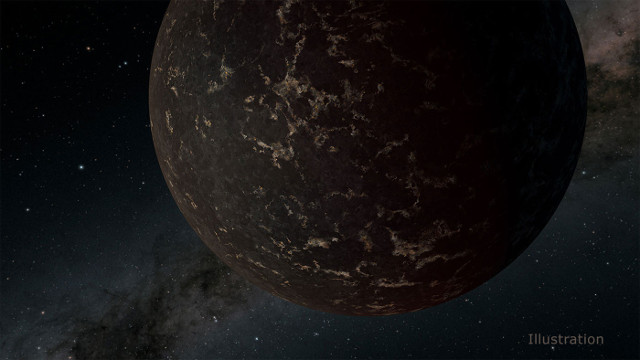
Artist's illustration of the exoplanet LHS 3844b (Image NASA/JPL-Caltech/R. Hurt (IPAC))

An article published in the journal “Nature” reports a study of the exoplanet LHS 3844b, a super-Earth discovered in 2018 thanks to NASA’s TESS space telescope. For this targeted study, a team of researchers led by Laura Kreidberg of the Harvard and Smithsonian Center for Astrophysics used the Spitzer space telescope to examine its surface and see if it had an atmosphere. The result is that LHS 3844b probably doesn’t have an atmosphere or it’s very thin and is perhaps covered by materials of volcanic origin such as the lunar “mare”. In essence, more than a super-Earth it could be a super-Mercury.

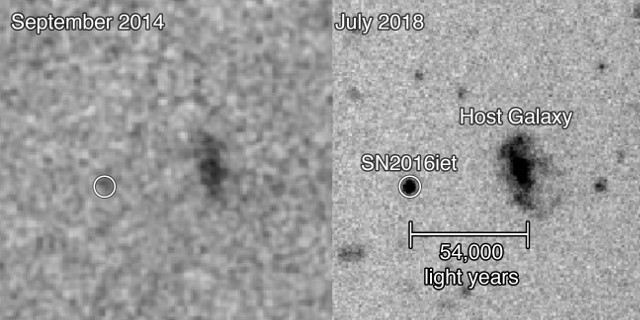
SN 2016iet is probably a pair-instability supernova

An article published in “The Astrophysical Journal” reports a study on the supernova SN 2016iet. A team of researchers used a number of telescopes to collect data on it. Almost three years of study have followed its first sighting, which happened on November 14, 2016, leading to estimate that the progenitor star had a mass about 200 times the Sun’s which exploded in what appears to be the first strong case of pair-instability supernova, which ends with the star’s total destruction.