Telescopes

Artist's impression of Sagittarius A* and S2

An article published in the journal “Astronomy & Astrophysics” describes a verification of a phenomenon predicted by Albert Einstein’s general theory of relativity. Scientists from the GRAVITY collaboration used observations conducted with ESO’s Very Large Telescope (VLT) in Chile to observe the effects of the motion of a star called S2 as it passes through the extreme gravitational field near the supermassive black hole at the center of the Milky Way.

Scheme of Hubble and Gaia at work (Image NASA, ESA, and A. Feild (STScI))

An article published in the journal “The Astrophysical Journal” describes a new measurement of the expansion of the universe. A team of astronomers led by Nobel Prize winner Adam Riess combined observations made with the Hubble Space Telescope and those made with ESA’s Gaia space probe, an observatory that specifically aims to map billions of objects in the sky including the variable stars called Cepheid variable used for those measurements. The new results increase the accuracy but also the discrepancy between the measures of the expansion of the near universe and those of the early universe.

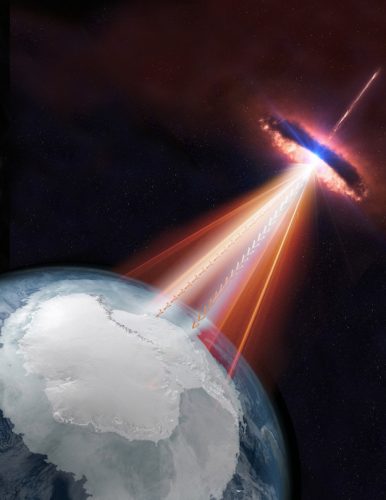
Artist's concept of a blazar emitting neutrinos and gamma rays (Image courtesy IceCube/NASA)

Various articles published in different journals shows various aspects of a research that allowed to associate a neutrino detected by the IceCube instrument at the South Pole to the blazar known as TXS 0506+056. In an article published in February 2018 in “The Astrophysical Journal Letters” a team led by Simona Paiano of the INAF of Padua showed that connection. In two articles just published in the journal “Science”, groups of scientists from 18 different observatories describe what was defined multimessenger observations of neutrino and electromagnetic emissions and a second analysis showing that other neutrinos detected by IceCube came from the same source.

The Eta Carinae system (Image NASA, ESA, and the Hubble SM4 ERO Team)

An article published in the journal “Nature Astronomy” describes a research on the Eta Carinae system, which consists of two giant blue stars with an overall brightness millions of times the Sun’s. A team led by astrophysicist Kenji Hamaguchi of NASA’s Goddard Space Flight Center used observations carried out with the NuSTAR telescope between March 2014 and June 2016 and other space telescopes to conclude that the two stars are probably accelerating very high energy particles and that some will reach the Earth in the form of cosmic rays.

The PDS 70 system (Image ESO/A. Müller et al.)

Two articles to be published in the journal “Astronomy & Astrophysics” describe the discovery and characterization of a planet still in its formation phase orbiting the young star PDS 70. Two teams of astronomers used the SPHERE instrument installed on ESO’s VLT to obtain for the first time images of a planet while it’s forming in what is still more or less a disk of gas and dust around the star. Called PDS 70b, the planet is a gas giant that could be larger than expected for its age.