Telescopes

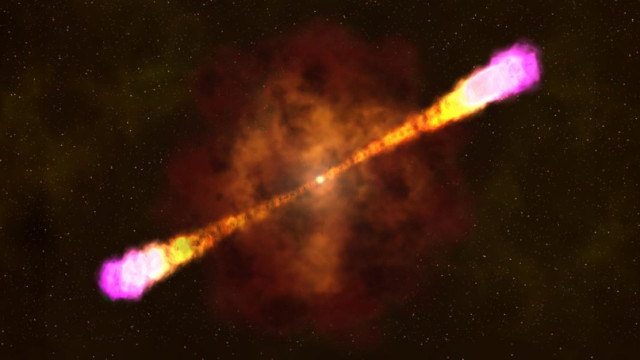
Artist's illustration of a gamma-ray burst (Image NASA’s Goddard Space Flight Center)

An article published in the journal “Nature” describes the observation of a gamma-ray burst named GRB 160625B. An international team of astronomers led by Eleonora Troja of the University of Maryland used a number of telescopes after its discovery with NASA’s Fermi space telescope to detect the properties of this extremely energetic event, its geometry, the orientation of its jets and the origin of its extremely bright optical flash.

Illustration of the method to estimate a comet's size (Image NASA/JPL-Caltech)

An article published in “The Astronomical Journal” describes a research on long-period comets concluding that they’re more common than expected. A team of researchers led by James Bauer of the University of Maryland used data collected by NASA’s WISE Space Telescope to discover that those at least one kilometer (0.6 miles) across are more common than expected and are, on average, twice as large as those of the Jupiter family.

The 5 H.E.S.S. telescopes (Photo H.E.S.S., MPIK/Christian Foehr)

An article published in the journal “Physical Review Letters” describes a new interpretation of observations made with NASA’s Fermi Gamma-ray Space Telescope and the High Energy Stereoscopic System (H.E.S.S.) observatory in Namibia. According to a team of Italian researchers led by Daniele Gaggero of the University of Amsterdam, at the center of the Milky Way there’s a kind of trap that focuses there some of the highest energy cosmic rays, the fastest particle of the galaxy.

EBLM J0555-57Ab compared to TRAPPIST-1, Jupiter and Saturn (Image courtesy Amanda Smith)

An article published in the journal “Astronomy & Astrophysics” describes the discovery of the star EBLM J0555-57Ab. It’s the smallest star ever discovered, with a size very to the planet Saturn’s. Its mass is about 85 times Jupiter’s but, despite being concentrated in a relatively small volume, has barely enough mass and density to maintain nuclear fusion of hydrogen and thus be a true star.

Exoplanets and binary systems (Image NASA/JPL-Caltech)

An article to be published in the “Astronomical Journal” describes a study of possible errors made in the density estimates of the exoplanets discovered using the transit method. Elise Furlan of Caltech/IPAC-NExScl and Steve Howell of NASA’s Ames Research Center analyzed the effect of the presence of a companion star on estimating the density of exoplanets in those systems, concluding that some of them are actually less dense than calculated.