
Telescopes

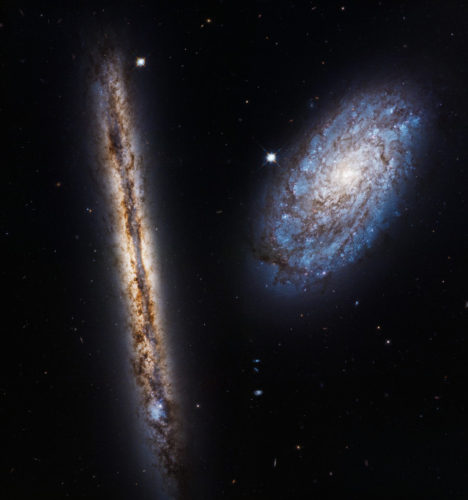
The galaxies NGC 4302 and NGC 4298 (Photo NASA, ESA, and M. Mutchler (STScI))

On April 25, 1990, the Hubble Space Telescope was put into orbit after being launched the day before on the Space Shuttle Discovery. To celebrate that event’s 27th anniversary representing a milestone in the history of astronomy, one of the many breathtaking photographs that accompanied Hubble’s activity was published, which in this case portrays two galaxies together, NGC 4302 and NGC 4298.

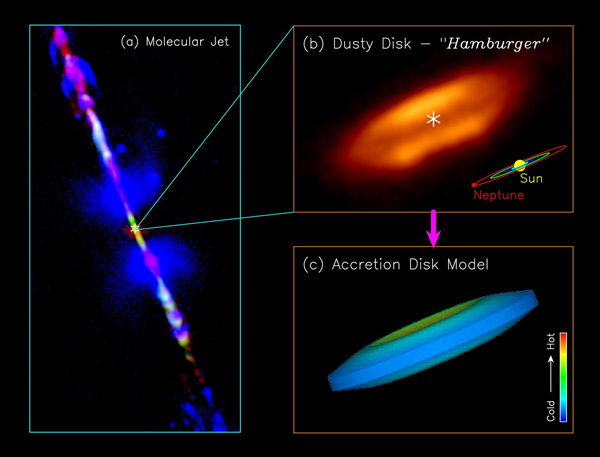
Images of the HH 212 system (Sources ALMA (ESO/NAOJ/NRAO)/Lee et al.)

An article published in the journal Science Advances describes the detection of a protostar named HH 212 that is feeding on an accretion disk. A team led by Chin-Fei Lee of the Academia Sinica Institute of Astronomy and Astrophysics (ASIAA, Taiwan) used the ALMA radio telescope to capture a moment of still little known phase of formation of stars and perhaps even of their planets.

Artist's concept of the planet LHS 1140b about to pass in front of its star (Image M. Weiss/CfA)

An article published in the journal “Nature” describes the discovery of a super-Earth called LHS 1140b. A team led by Jason Dittmann of the Harvard-Smithsonian Center for Astrophysics used the HARPS instrument installed on ESO’s 3.6-meter telescope in La Silla, Chile, to study that exoplanet after identifying it with the MEarth-South telescope at Cerro Tololo Inter-American Observatory. Its location in ​​its solar system’s habitable zone makes it particularly interesting.

Example of galaxy pair connected by dark matter filaments (Image courtesy S. Epps & M. Hudson / University of Waterloo)

An article published in the journal “Monthly Notices of the Royal Astronomical Society” describes a research on dark matter filaments that connect two galaxies. A team of astronomers led by Mike Hudson of the University of Waterloo in Canada exploited a weak gravitational lensing effect to create an image that shows even if indirectly a kind of dark matter bridge between two galaxies.

2014 UZ224 / DeeDee seen by ALMA (Image ALMA (ESO/NAOJ/NRAO))

An article accepted for publication in the “Astrophysical Journal Letters” describes the research that followed the discovery of a possible dwarf planet called 2014 UZ224 and nicknamed DeeDee, as in Distant Dwarf. A team led by David Gerdes of the University of Michigan announced its discovery in October 2016 and thanks to a further observation carried out by the ALMA radio telescope they estimated other features.