Telescopes

The quasar 3C 186 and its galaxy (Image NASA, ESA, and M. Chiaberge (STScI and JHU))

An article published in the journal “Astronomy & Astrophysics” describes the discovery of a supermassive black hole pushed out from its galaxy’s core. A team of astronomers led by Marco Chiaberge of the Space Telescope Science Institute in the USA used the Hubble Space Telescope to observe the quasar 3C 186 in which this phenomenon occurred. Another interesting element is that the black hole’s movement may have been accelerated by gravitational waves.

Artist's concept of primordial spiral galaxy with quasar in the background (Image A. Angelich (NRAO/AUI/NSF))

An article published in the journal “Science” describes a research about two very young galaxies that probably look very wimilar to the Milky Way 12 billion years ago. Called ALMA J081740.86+135138.2 and ALMA J120110.26+211756.2, they were observed by a team of astronomers using the ALMA radio telescope as a follow-up of previous research conducted using the light from a quasar behind the two galaxies. The new research showed that the two galaxies are surrounded by a halo of gas and that their star formation rate is rather high.

The runaway stars and their positions (Image NASA, ESA, K. Luhman (Penn State University), and M. Robberto (STScI))

An article published in “The Astrophysical Journal Letters” describes a research about what used to be a multiple system in the Orion Nebula. A team of researchers led by Kevin Luhman of Penn State University used the Hubble Space Telescope to discover a runaway star that was part of the original system with two other stars already known that are also traveling at high speeds. The three stars were part of a single system untile about 540 years ago.

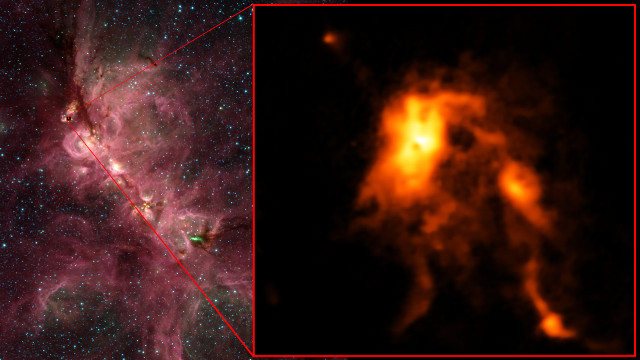
The Cat's Paw Nebula and the protostar NGC 6334I-MM1 (Image ALMA (ESO/NAOJ/NRAO), T. Hunter; C. Brogan, B. Saxton (NRAO/AUI/NSF); GLIMPSE, NASA/JPL-Caltech)

An article published in “Astrophysical Journal Letters” describes the study of a protostar indicated as NGC 6334I-MM1 which increased its brightness 100 times. A team led by astronomer Todd Hunter of the National Radio Astronomy Observatory (NRAO) discovered this transformation by comparing new observations carried out with the ALMA radio telescope with other ones previously carried out with the SMA radio telescope.

Artist's impression of the X9 system with the view from Chandra X-ray Observatory in the inset (Image X-ray: NASA/CXC/University of Alberta/A.Bahramian et al.; Illustration: NASA/CXC/M.Weiss)

An article published in the journal “Monthly Notices of the Royal Astronomical Society” describes a research on what appears to be a binary system including a star with the closest orbit around a black hole. A team of astronomers used NASA’s Chandra X-ray Observatory and NuSTAR space Telescope and the Australia Telescope Compact Array (ATCA) to observe this system called X9 concluding that the star, a white dwarf, takes 28 minutes to orbit the black hole.