Telescopes

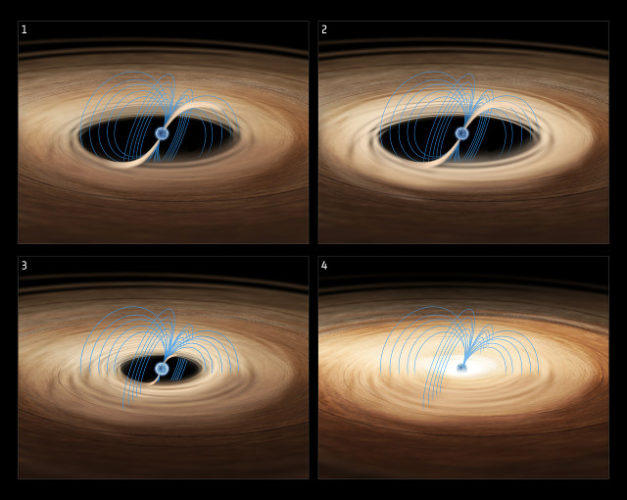
Artist's impression of Rapid Burster (Image ESA/ATG medialab)

An article published in the journal “Monthly Notices of the Royal Astronomical Society” describes a research that provides an explanation for an astronomical mystery dating back to the 1970s. A team of researchers of the Anton Pannekoek Institute for Astronomy in Amsterdam led by Jakob van den Eijnden discovered a gap in the accretion disk of the binary system MXB 1730-335, known as Rapid Burster for its rapid and discontinuous X-ray flashes.

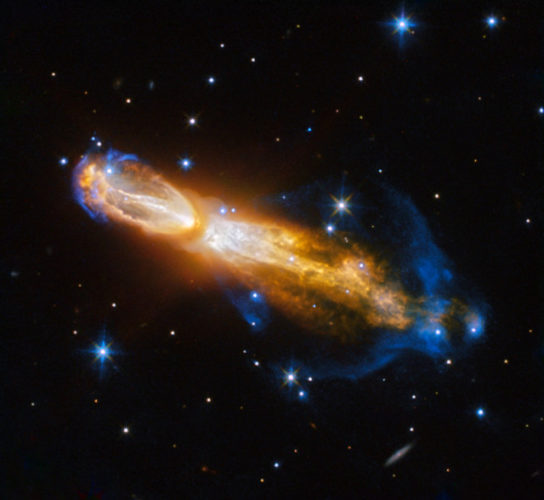
The Calabash Nebula (Image ESA/Hubble & NASA. Acknowledgement: Judy Schmidt)

A photograph taken by the Hubble Space Telescope shows the Calabash Nebula, a protoplanetary nebula showing the agony of a low-mass star like the Sun. This nebula is also known by the nickname Rotten Egg Nebula because its study revealed that in the gas surrounding it there’s a high concentration of sulfur, the element that causes the characteristic rotten egg smell.

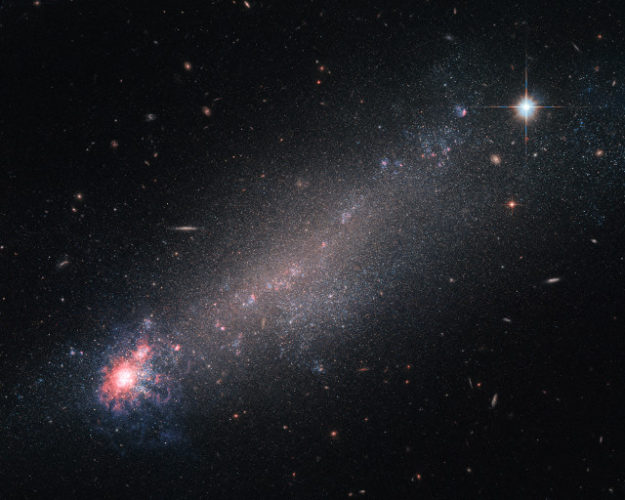
NGC 4861 (Image ESA/Hubble & NASA)

A team of researchers proposed an explanation for the strange appearance of the galaxy NGC 4861, which has the characteristics of a barred spiral galaxy but it looks more like a dwarf irregular galaxy. It’s possible that there’s an ongoing production of charged particle jets during a star formation phase with the generation of galactic winds that explain the strange shape of NGC 4861, similar to a comet.

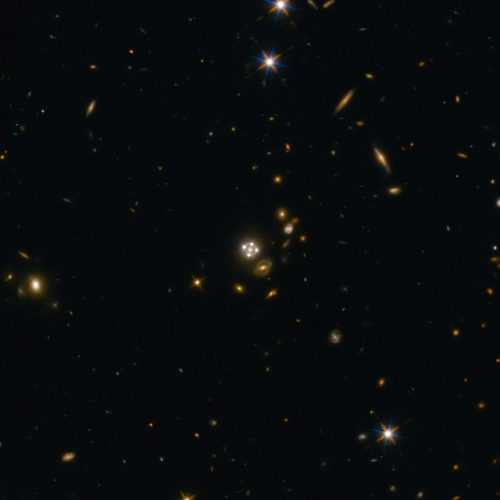
The quasar HE0435-1223 seen through a gravitational lens that creates four images of it (Image ESA/Hubble, NASA, Suyu et al.)

A series of articles about to be published in the journal “Monthly Notices of the Royal Astronomical Society” describes various aspects of a new calculation of the Hubble constant, the value indicating the rate of expansion of the universe. A team of the H0LiCOW collaborative used the Hubble Space Telescope and other telescopes to measure the Hubble constant using the effect of gravitational lensing of 5 galaxies.

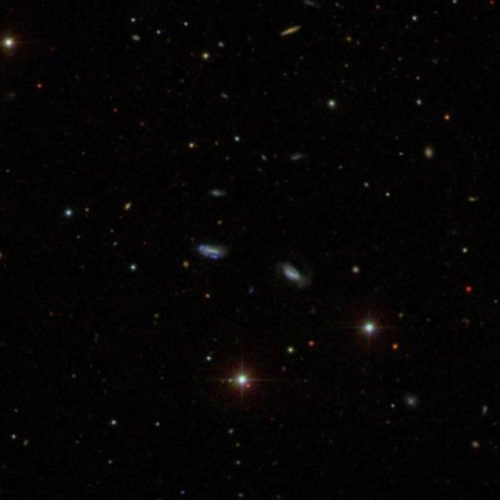
A group of dwarf galaxies (Image courtesy Sloan Digital Sky Survey)

An article published in the journal “Nature Astronomy” describes the discovery of seven groups of dwarf galaxies that show the conditions for starting the merger process that will lead to form galaxies like the Milky Way. A team of researchers led by Sabrina Stierwalt of the National Radio Astronomy Observatory (NRAO) identified seven groups starting from data of the TiNy Titans (TNT) survey then carried out specific studies.