
Telescopes

Artistic representation of millisecond pulsar deforming its compaion star (Image NASA)

An article published in “The Astrophysical Journal” describes a study of a binary system consisting of a millisecond pulsar known as PSR J1723-2837 and a small common star. Astrophysicist John Antoniadis of the University of Toronto and the amateur astronomer AndrĂ© van Staden discovered for the first time starspots and a powerful magnetic field in a millisecond pulsar’s companion. It’s a research that can help better understand this type of pulsar’s behavior.

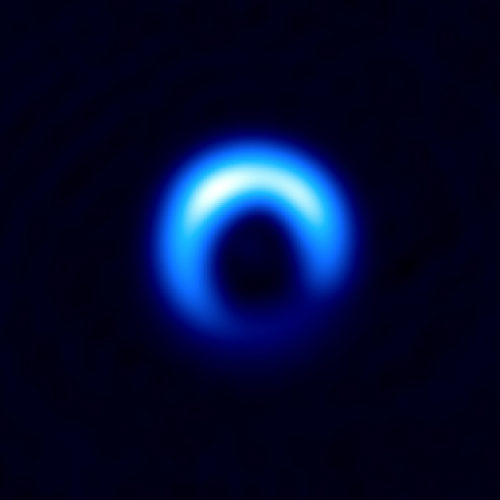
Protoplanetary disk in the HD 142527 system (Image ALMA (ESO/NAOJ/NRAO), Kataoka et al.)

An article published in “The Astrophysical Journal Letters” describes a new research on young system HD 142527. The ALMA radio telescope had already been used in the past to study the protoplanetary disk around the star but this time an international team of astronomers led by Akimasa Kataoka measured with precision the size of the dust particles that form it.

Summary of the research on K2-3d (Image courtesy National Astronomical Observatory of Japan)

An article published in “The Astronomical Journal” describes a research on the exoplanet K2-3d. This is a super-Earth discovered using the Kepler space telescope. An international team of researchers added more data collected later by the Spitzer space telescope and the Okayama Astrophysical Observatory’s telescope to get a more accurate measurement of this potentially habitable planet’s orbital period.

Area around the Milky Way's center (Image courtesy Alex Mellinger)

An article published in the journal “Monthly Notices of the Royal Astronomical Society” describes the discovery of a new family of stars at the center of the Milky Way tha are unusually nitrogen-rich. A team of astronomers from the Liverpool John Moores University (LJMU) made this discovery working on the APOGEE (the Apache Point Observatory Galactic Evolution Experiment) project, which aims to collect infrared data of hundreds of thousands of stars in the Milky Way.

Cygnus X-3 and little friend (Image X-ray: NASA/CXC/SAO/M.McCollough et al, Radio: ASIAA/SAO/SMA)

An article published in “The Astrophysical Journal Letters” describes a research on Cygnus X-3, a binary system consisting of a massive star slowly consumed by its companion, a black hole or a neutron star that is gas continuously taking gas away from it. A team of researchers used NASA’s Chandra X-ray Observatory and the Smithsonian’s Submillimeter Array (SMA) to detect the emissions generated from Cygnus X-3, reflected by a star-forming cloud.