Telescopes

The galaxy UGC 9391 seen by the Hubble Space Telescope. Cepheid variable are in red circles, a type Ia supernova is marked by a blue cross (Image NASA, ESA, and A. Riess (STScI/JHU))

An article accepted for publication in “The Astrophysical Journal” describes a research based on observations made with the Hubble Space Telescope that suggests that the universe is expanding at a faster rate than expected. A team of astronomers led by Nobel laureate Adam Riess measured the distance of stars in nineteen galaxies with the best accuracy ever achieved to obtain this surprising result.

Representation of a solar superflare (Image NASA's Goddard Space Flight Center, Greenbelt, Md.)

An article published in the journal “Nature Geoscience” describes a study on the relationship between super solar flares of a few billion years ago and the emergence of life forms on Earth. According to a team of NASA scientists led by Vladimir Airapetian those gigantic storms provided the energy needed to warm up the Earth and to trigger some chemical reactions needed to form complex molecules such as RNA and DNA on which life is based.

Artistic representation of a supermassive black hole seed. The inset boxes show a candidate seen by Chandra (top) and by Hubble (bottom) (Image X-ray: NASA/CXC/Scuola Normale Superiore/F. Pacucci, et al. Optical: NASA/STScI. Illustration: NASA/CXC/M. Weiss)

An article that will be published in the journal “Monthly Notices of the Royal Astronomical Society” describes a research on the origin of supermassive black holes. A team of Italian scientists led by Fabio Pacucci of Scuola Normale Superiore of Pisa used NASA’s space telescopes to identify two ancient objects that represent the best candidates black hole “seeds” found so far.

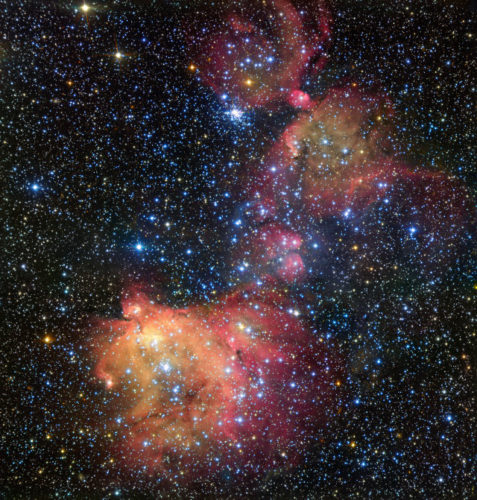
The LHA 120-N55 nebula photographed by the VLT (Photo ESO)

ESO released new photos of the nebula LHA 120-N55 – usually called simply N55 – taken with the VLT (Very Large Telescope). It’s an emission nebula located inside a so-called superbubble called CML 4 and has a halo that in the images has various colors like a cloak adorning recently formed stars and consists of gas remained after most of it was absorbed by those stars.