Telescopes

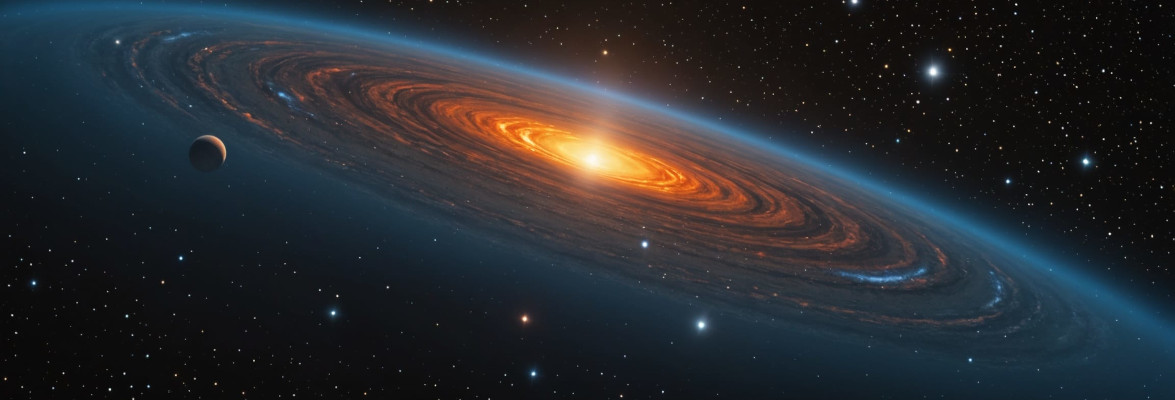
Artistic representation of the gas halo surrounding the Milky Way and the Magellanic Clouds (Image NASA/CXC/M.Weiss/Ohio State/A Gupta et al)

An article published in “The Astrophysical Journal” describes a research on the huge halo of gas surrounding the Milky Way. A group of astronomers at the University of Michigan used data from ESA’s XMM-Newton telescope’s archives to discover that the galaxy’s halo spins in the same direction and at a speed comparable with its disk. This discovery may help better understand the formation of galaxies and solar systems within them.

Artistic concept of two exoplanets transiting in front of the TRAPPIST-1 star (Image NASA/ESA/STScI/J. de Wit (MIT))

An article published in the journal “Nature” describes a research on two exoplanets of the TRAPPIST-1 system. A group of researchers led by Julien de Wit of the Massachusetts Institute of Technology in Cambridge, Massachusetts used the Hubble and Spitzer space telescopes to better examine two of the three exoplanets whose discovery was announced in May 2016.

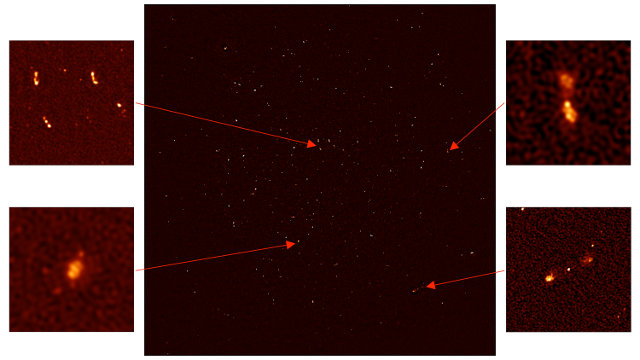
The galaxies seen by MeerKAT with some in details in the insets (Image courtesy SKA Africa. All rights reserved)

The radio telescope MeerKAT has been activated and the first images of the observations have been released. MeerKAT’s sensitivity was immediately demonstrated because in the observed area 70 galaxies were known but over 1300 have been detected. It’s a great achievement for one of the precursors of the SKA project, the next-generation radio telescope whose activation is scheduled for 2020.

Artistic concept of the V883 Orionis system with its protoplanetary disc and the snow in it (Image A. Angelich (NRAO/AUI/NSF)/ALMA (ESO/NAOJ/NRAO))

An article published in the journal “Nature” describes the first observation ever of the water snow line in the V883 Orionis system. Using the ALMA radio telescope, a team led by Lucas Cieza of the Universidad Diego Portales, Santiago, Chile, identified the distance from the star beyond which the temperature drops enough for water to freeze.

The galaxy cluster 3C 129 observed by various telescope (Image NRAO, ROSAT satellite; the Two Micron All Sky Survey)

An article published in the journal “Monthly Notices of the Royal Astronomical Society” is the first produced thanks to a study that includes observations of the Sardinia Radio Telescope (SRT). Its target was a supermassive black hole at the center of an elliptical galaxy about 300 million light years away from Earth that is falling toward the galaxy cluster 3C 129.