
Telescopes

Illustration of a hot Jupiter planet with its clouds (Image NASA/JPL-Caltech)

An article published in “The Astrophysical Journal” describes a research about the possible presence of water in the planets of the type called hot Jupiter. Those are gas giants just like Jupiter but orbit very close to their stars and consequently have very high surface temperatures. A team of scientists at NASA’s JPL led by Aishwarya Iyer tried to understand why the atmosphere of some hot Jupiters doesn’t seem to contain water.

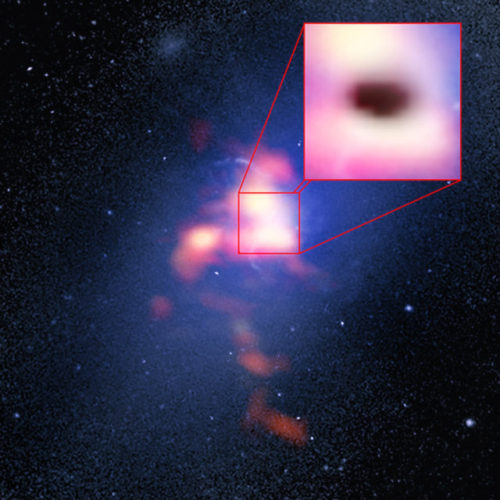
In the background an image taken by the Hubble Space Telescope. In red the gas seen by ALMA (Image B. Saxton (NRAO/AUI/NSF)/G. Tremblay et al./NASA/ESA Hubble/ALMA (ESO/NAOJ/NRAO))

An article published in the journal “Nature” describes the observation of an intergalactic deluge of gases that from large clouds are falling toward the supermassive black hole at the center of a galaxy in the Abell 2597 cluster. By using the ALMA radio telescope a team of astronomers led by Grant Tremblay of Yale University discovered the first evidence that these huge black holes can gorge on gas through chaotic and clumpy rains of giant clouds of very cold molecular gas.

The galaxy UGC 9391 seen by the Hubble Space Telescope. Cepheid variable are in red circles, a type Ia supernova is marked by a blue cross (Image NASA, ESA, and A. Riess (STScI/JHU))

An article accepted for publication in “The Astrophysical Journal” describes a research based on observations made with the Hubble Space Telescope that suggests that the universe is expanding at a faster rate than expected. A team of astronomers led by Nobel laureate Adam Riess measured the distance of stars in nineteen galaxies with the best accuracy ever achieved to obtain this surprising result.

Representation of a solar superflare (Image NASA's Goddard Space Flight Center, Greenbelt, Md.)

An article published in the journal “Nature Geoscience” describes a study on the relationship between super solar flares of a few billion years ago and the emergence of life forms on Earth. According to a team of NASA scientists led by Vladimir Airapetian those gigantic storms provided the energy needed to warm up the Earth and to trigger some chemical reactions needed to form complex molecules such as RNA and DNA on which life is based.