
Telescopes

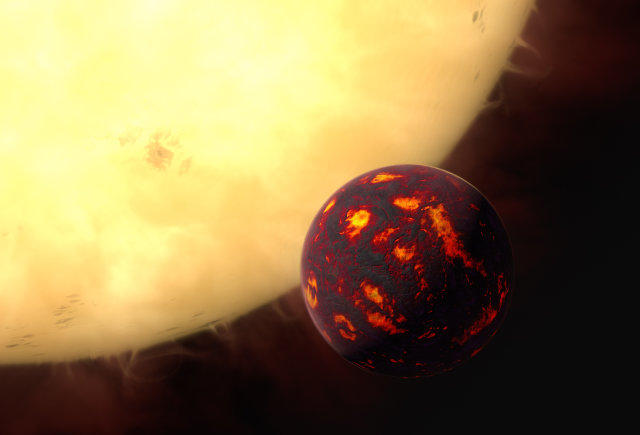
Artist’s impression of the exoplanet 55 Cancri e in front of its parent star (Image ESA/Hubble, M. Kornmesser)

An article published in the journal “The Astrophysical Journal” describes a research on the planet 55 Cancri e focused in particular on its atmosphere. This is the first study of its kind involving a super-Earth and was carried out in an innovative way using the Hubble Space Telescope. 55 Cancri e has already been the subject of several studies and about four years ago was the first super-Earth directly observed.

Artistic representation of the WFIRST Space Telescope (Image NASA/GSFC/Conceptual Image Lab)

NASA announced the approval of a new astrophysics mission based on a space telescope called WFIRST (Wide-Field Infrared Survey Telescope). It’s a next-generation Instrument for a long-term project since it will be probably launched around the middle of next decade. It will have a mirror as large as Hubble’s but a field of view a hundred times wider to investigate even better on the secrets of the universe.

The Astro-H space telescope blasting off atop an H-IIA rocket (Image courtesy JAXA)

A little while ago the Japanese Astro-H space telescope was launched from the Tanegashima Space Center on a H-IIA rocket. After about fifteen minutes it regularly separated from the rocket’s last stage. It will reach the low-Earth orbit, where it will be positioned at an altitude of about 575 kilometers (about 357 miles).

An image of the HD 142527 binary star system from observations made with the ALMA radio telescope (Image Andrea Isella/Rice University; B. Saxton (NRAO/AUI/NSF); ALMA (NRAO/ESO/NAOJ)

At the meeting of the AAAS (American Association for the Advancement of Science) just concluded in Washington, D.C. the latest results were presented about the observations of the HD 142527 star system carried out with the ALMA radio telescope. It’s been an object of study by astronomers for some time and is particularly interesting because it’s very young. This means that around the central star there’s a ring of gas and dust that is probably forming one or more planets but there’s also a second star. This type of study will help to understand the formation of planets in binary systems.

Panoramic view of the galaxies in the local supercluster (Image IPAC/Caltech, by Thomas Jarrett)

An article published in the journal “Astronomical Journal” describes a research that offers at least a partial explanation for the cosmic phenomenon called the Great Attractor. An international team used the 64-meter Parkes radio telescope in Australia to make observations through the galactic Zone of Avoidance, an area of space obscured by the Milky Way itself with its stars and dust clouds. In this way the researchers found hundreds of previously unknown galaxies, ea progress in the gravitational anomaly’s explanation.