Telescopes

An image of the HD 142527 binary star system from observations made with the ALMA radio telescope (Image Andrea Isella/Rice University; B. Saxton (NRAO/AUI/NSF); ALMA (NRAO/ESO/NAOJ)

At the meeting of the AAAS (American Association for the Advancement of Science) just concluded in Washington, D.C. the latest results were presented about the observations of the HD 142527 star system carried out with the ALMA radio telescope. It’s been an object of study by astronomers for some time and is particularly interesting because it’s very young. This means that around the central star there’s a ring of gas and dust that is probably forming one or more planets but there’s also a second star. This type of study will help to understand the formation of planets in binary systems.

Panoramic view of the galaxies in the local supercluster (Image IPAC/Caltech, by Thomas Jarrett)

An article published in the journal “Astronomical Journal” describes a research that offers at least a partial explanation for the cosmic phenomenon called the Great Attractor. An international team used the 64-meter Parkes radio telescope in Australia to make observations through the galactic Zone of Avoidance, an area of space obscured by the Milky Way itself with its stars and dust clouds. In this way the researchers found hundreds of previously unknown galaxies, ea progress in the gravitational anomaly’s explanation.

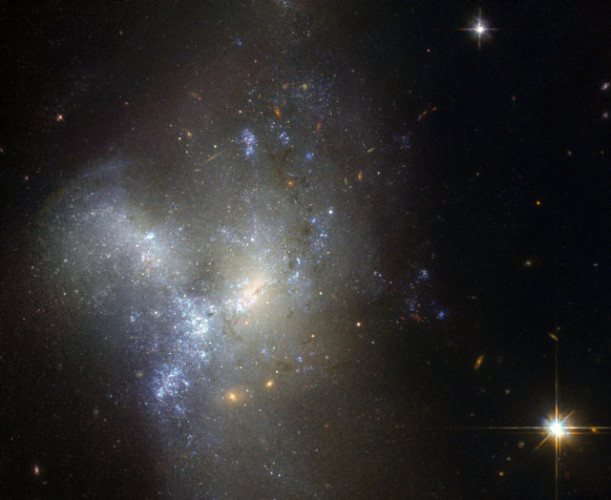
The galaxy NGC 1487 photographed by the Hubble Space Telescope (Image ESA/Hubble & NASA / Judy Schmidt)

The Hubble Space Telescope photographed a really peculiar galaxy called NGC 1487. It was defined an event rather than a celestial object because it’s the result of a merger between two but perhaps even more galaxies that formed something very different. Astronomers are unable to say how many galaxies were involved in the phenomenon nor what they looked like. This merger probably caused the birth of many new giant stars.

Diagram of the Smith Cloud's trajectory (Image NASA/ESA/A. Feild (STScI))

An article published in “The Astrophysical Journal Letters” describes a research about the so-called “”Smith Cloud” (or “Smith’s Cloud”). It’s a giant cloud of hydrogen which is currently outside of the Milky Way but is heading towards our galaxy at about 1.1 million km/h (almost 700,000 mph). Observations made using the Hubble Space Telescope suggest that it was ejected from the Milky Way galaxy about 70 million years ago and now is coming back.

The dwarf galaxy IC 1613 photographed by the OmegaCAM on ESO's VST (Image ESO)

The OmegaCAM camera mounted on ESO’s VST (VLT Survey Telescope) was used to take a picture of the dwarf galaxy IC 1613. It has the distinction of being really clean, meaning that it contains very little dust while most galaxies contain dust clouds or are even full of it. The very low dust content of IC 1613 allows astronomers to observe its inside and is therefore an excellent target for astronomy and astrophysics studies.