Telescopes

Artist’s impression of the white dwarf WD 0816-310 with its magnetic field and the debris that surrounds it (Image ESO/L. Calçada)

An article published in “The Astrophysical Journal Letters” reports the results of a study of the white dwarf cataloged as WD 0816-310 and of what was defined as a scar on its surface, left by the materials of a large asteroid that got swallowed. A team of researchers used ESO’s VLT (Very Large Telescope) in Chile to obtain the information necessary to identify the metallic elements that form that scar and its concentration in a specific area, which is one of its magnetic poles. This result offers new insights into the evolution of planetary systems after the death of their star.

The remnant of the supernova SN 1987A as seen by the James Webb Space Telescope

An article published in the journal “Science” reports new evidence that the supernova SN 1987A generated a pulsar. A team of researchers used observations conducted with the James Webb Space Telescope to detect the effects of high-energy emissions coming from the pulsar or the pulsar wind nebula, a nebula that surrounds it and is powered by the pulsar. These are confirmations of conclusions reached by other teams of researchers in recent years using observations in other electromagnetic bands.

The region of sky where quasar J0529-4351 is located. It was created from images forming part of the Digitized Sky Survey 2 while the inset shows the position of this quasar in the center in an image from the Dark Energy Survey.

An article published in the journal “Nature Astronomy” reports the identification of the brightest and most voracious quasar discovered so far, cataloged as J0529-4351. A team of researchers used various instruments to understand that it wasn’t a nearby star but a primordial quasar we see as it looked over 12 billion years ago.

The researchers estimated that the mass of the supermassive black hole that powers it is about 17 billion times the Sun’s, and it’s devouring materials around it at a very high rate, about the mass of the Sun every day. The study of this record-breaking primordial quasar can help reconstruct the history of the early universe and the processes that led to it becoming what it is today.

A part of the IRAS 16562–3959 area (Image ESA/Hubble & NASA, R. Fedriani, J. Tan)

An image captured by the Hubble Space Telescope shows a part of the star-forming area cataloged as IRAS 16562–3959. The Wide Field Camera 3 (WFC3) instrument offers many details of that area at infrareds, in particular of the emissions coming from a massive star still in its formation phase whose consequences are visible in the part of the image that goes from the center towards the upper left and lower right. These and many other details can help reconstruct star formation processes.

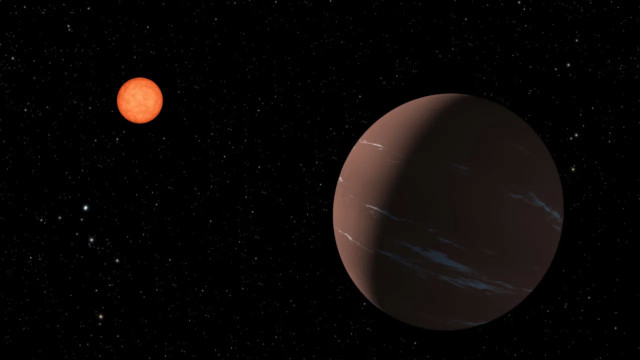
Artist's concept of the exoplanet TOI-715b with its star in the background (Image NASA / JPL-Caltech)

An article published in the journal “Monthly Notices of the Royal Astronomical Society” reports the identification of the exoplanet TOI-715 b in an orbit around its star in a position that meets the most conservative definition of a habitable zone. A team of researchers used observations conducted with NASA’s TESS space telescope confirmed by other instruments to identify what appears to be a super-Earth with a radius about 1.5 times the Earth’s. A second exoplanet candidate was discovered that would have a size very similar to the Earth’s a little further away from its star but follow-up observations are needed to verify that it’s not a false positive.