Telescopes

M87 with its supermassive black hole and the jet it produces (Image R.-S. Lu (SHAO), E. Ros (MPIfR), S. Dagnello (NRAO/AUI/NSF))

An article published in the journal “Nature” reports the results of the first observations ever obtained of the ring structure showing matter falling into the supermassive black hole at the center of the galaxy M87. A team of researchers used the ALMA and GLT radio telescopes and some of the ones part of the GMVA array to obtain the images they were looking for. These images show not only the area around the black hole but also the flows of materials that originate a relativistic jet. The collected data is useful to understand the mechanisms that lead those jets to reach the energies necessary to be accelerated to speeds approaching the speed of light.

The galaxy cluster Abell 2744 and its surrounding area, including the views distorted by gravitational lensing of galaxies behind it. Among them are the seven galaxies identified in the A2744-z7p9OD protocluster, also seen in the insets.

An article published in “The Astrophysical Journal Letters” reports the evidence for the discovery of the oldest galaxy protocluster known so far. A team of researchers led by Takahiro Morishita of Caltech identified the cluster in its formation phase which was cataloged as A2744-z7p9OD with the Hubble Space Telescope and then confirmed with the James Webb Space Telescope the presence of at least seven galaxies. They were forming a larger structure about 650 million years after the Big Bang and according to calculations, the cluster has grown over time to include many other galaxies.

The image showing the area around the supermassive black hole at the center of the galaxy M87 in the version published in 2019 and in the one reprocessed with the PRIMO system

An article published in “The Astrophysical Journal Letters” reports the results of using a machine learning system to obtain a sharper and more detailed version of the image showing the area around the supermassive black hole at the center of the galaxy M87. Lia Medeiros (Institute for Advanced Study), Dimitrios Psaltis (Georgia Tech), Tod Lauer (NOIRLab), and Feryal Özel (Georgia Tech), all members of the Event Horizon Telescope (EHT) Collaboration that obtained the image that has become famous, developed the PRIMO system to reprocess the data collected during the original observation campaign in 2017. Their aim is to obtain the maximum possible resolution with all the details present in the data collected by the various radio telescopes participating in the EHT Collaboration. The image, to which the four researchers hold the rights, shows the comparison between the famous result published in 2019 and that of the first test with PRIMO.

The galaxy Arp 220 as seen by the James Webb Space Telescope

An image (NASA, ESA, CSA, STScI. Image processing: Alyssa Pagan (STScI)) captured by the James Webb Space Telescope portrays Arp 220, a galaxy that is the result, still not fully completed, of a galaxy merger. Intense processes are ongoing within this new galaxy as a consequence, starting with a remarkable star formation activity. X-ray emissions detected by other instruments suggest the presence of an active galactic nucleus. These are activities connected to its nature as an ultraluminous infrared galaxy (ULIRG) whose emissions allowed Webb to capture many new details.

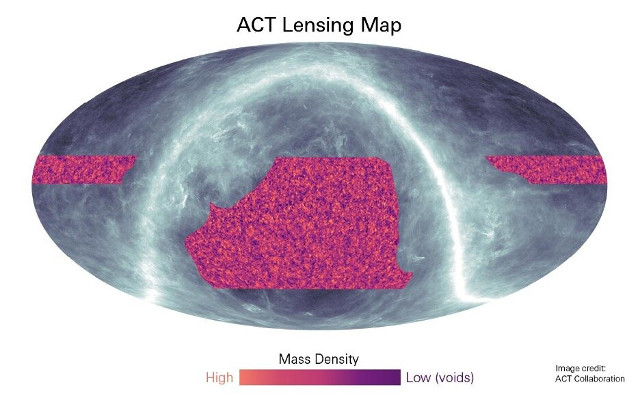
The map of dark matter based on observations from the Atacama Cosmology Telescope

During the Future Science with CMB x LSS conference underway at Kyoto University, Japan, the results of a detailed mapping of dark matter in a part of the universe were presented. Three articles available in preview and submitted to “The Astrophysical Journal” illustrate these results, obtained using observations conducted at the Atacama Cosmology Telescope (ACT) in Chile, which operated between 2007 and 2022. This map (Image courtesy ACT Collaboration) was obtained by analyzing the cosmic microwave background radiation and its deviations caused to the gravity of massive structures such as concentrations of dark matter.