Telescopes

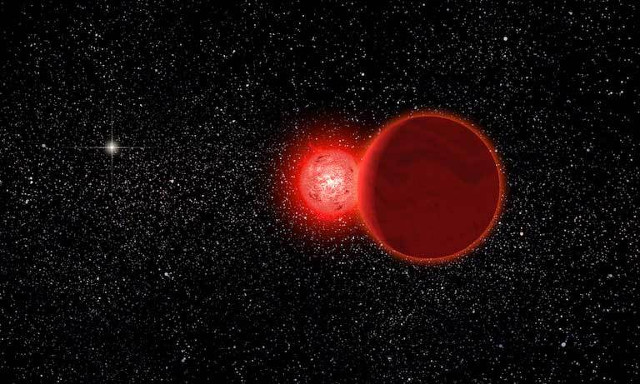
Artist's concept of Scholz's star with its companion, a binary system that might be similar to LP 413-53AB (Image Michael Osadciw/University of Rochester)

An article published in “The Astrophysical Journal Letters” reports the discovery that the system cataloged as LP 413-53AB consists of two ultracool dwarf stars that orbit each other in just 17 hours. A team of researchers led by Chih-Chun “Dino” Hsu of Northwestern University used observations conducted with the Keck Observatory telescopes to resolve two stars so small and so close. Previously, three binary systems composed of ultracool dwarfs had been discovered but they were young stars in astronomical terms while the pair of LP 413-53AB is estimated to be some billion years old. We don’t know how difficult these pairs are to find due to their weak emissions, and explaining the existence of LP 413-53AB is difficult.

Tycho supernova remnants (X-ray (IXPE: NASA/ASI/MSFC/INAF/R. Ferrazzoli, et al.), (Chandra: NASA/CXC/RIKEN & GSFC/T. Sato et al.) Optical: DSS Image processing: NASA/CXC/SAO/K. Arcand, L.Frattare & N.Wolk)

An article to be published in “The Astrophysical Journal” reports a study on Tycho supernova remnants which offers new information on the geometry of its magnetic fields. A team of astronomers led by Riccardo Ferrazzoli of the Italian National Institute of Astrophysics used observations conducted with the IXPE space telescope to examine the polarized X-rays emitted by these supernova remnants. This allowed new clues to be found about the conditions in the shock waves generated by the supernova that accelerate particles to speeds close to the speed of light.

The jellyfish galaxy JO201 (Image ESA/Hubble & NASA, M. Gullieuszik)

An article in publication and an article under peer-review in “The Astrophysical Journal” report various aspects of a study of 6 so-called jellyfish galaxies. A team of researchers used various instruments to examine them and try to understand the processes taking place in the “tentacles” generated by the gas stripped from those galaxies during the passage within a galaxy cluster. In that space, there’s intergalactic plasma that generates a pressure that caused that gas loss in a process called ram pressure stripping. An image of the jellyfish galaxy cataloged as JO201 captured by the Hubble Space Telescope was published by ESA.

Mirabilis, Elstir and Vinteuil in a combination of X-ray and optical frequency observations

An article being published in “The Astrophysical Journal” reports the results of the study of two galaxy mergers between dwarf galaxies with active galactic nuclei. A team of researchers used data collected by NASA’s Chandra X-ray Observatory to discover candidates and then compared them with infrared observations conducted with NASA’s WISE Space Telescope and optical frequency observations conducted with the Canada-France-Hawaii Telescope (CFHT).

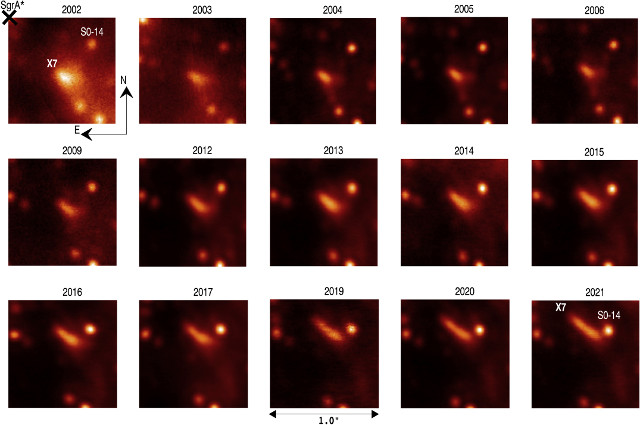
Some images captured by the NIRC2 instrument using adaptive optics showing the evolution of X7 between 2002 and 2021

An article published in “The Astrophysical Journal” reports the results of twenty years of observations of a giant filament of gas and dust that is progressively approaching Sagittarius A*, the supermassive black hole at the center of the Milky Way. A team of researchers from the Keck Observatory and UCLA’s Galactic Center Orbits Initiative (GCOI) used Keck’s OSIRIS and NIRC2 instruments to keep an eye on this filament, cataloged as X7, to study its orbit and shape’s evolution. According to predictions, in 2036, X7 will get close to Sagittarius A* to the point of dissipating and be devoured. This will be a really interesting event to study even more deeply what happens in that really extreme environment.