Telescopes

The Moon, water, and the SOFIA flying telescope

Two articles published in the journal “Nature Astronomy” report as many studies on the presence of water on the Moon. A team of researchers used the SOFIA flying telescope to find direct evidence of the presence of water molecules even in regions other than the polar ones. Another team examined the so-called cold traps, regions in the shadows on the lunar surface where there’s perennial darkness that can allow the presence of water ice, mapping their distribution. In the end, the amount of water present on the Moon may be far greater than that known from previous research. However, there are still various questions, starting with the possibility that it’s partly present in glass beads and therefore not immediately usable in space missions.

Io and Jupiter

An article accepted for publication in “The Planetary Science Journal” reports a study on Io, one of Jupiter’s satellites, which specifically concerns its volcanoes. A team of researchers led by astronomer Imke de Pater of the University of Berkeley, USA, used the ALMA radio telescope to examine Io’s atmosphere as it enters and leaves Jupiter’s shadow, a phenomenon called an eclipse. That’s because during an eclipse it receives no sunlight, temperatures drop to the point that only the sulfur dioxide emitted by volcanoes is warm enough not to solidify. The conclusion is that between 30% and 40% of Io’s atmosphere is generated by volcanic activity. The researchers also found that some volcanoes emit not sulfur compounds but potassium chloride.

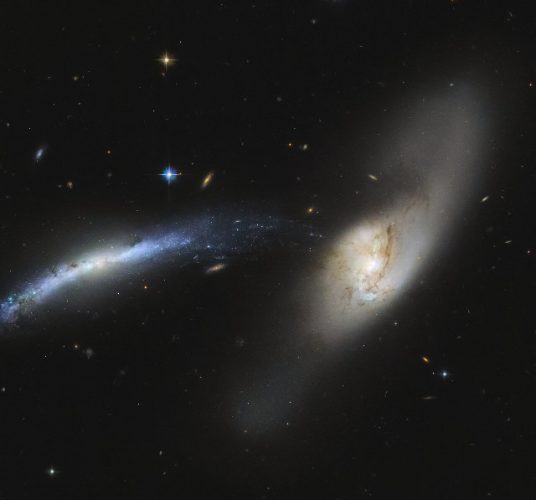
Arp 283 (NGC 2799 and NGC 2798) (Immagine ESA/Hubble & NASA, SDSS, J. Dalcanton Acknowledgement: Judy Schmidt (Geckzilla))

A photo taken by the Hubble Space Telescope shows Arp 283, which is not a single object but a pair of galaxies classified as NGC 2798 (on the right) and NGC 2799 (on the left). Astronomer Halton Arp put this pair in his catalog of peculiar galaxies because they are two interacting galaxies, which means they’re affected by each other’s force of gravity. Arp 283 was compared to a waterspout with stars from NGC 2799 appearing to fall towards NGC 2798 like drops of water. In the distant future, the two galaxies could merge.

Betelgeuse seen by the SPHERE instrument in December 2019 (Image ESO/M. Montargès et al.)

An article published in “The Astrophysical Journal” reports a study of the star Betelgeuse that concludes that it’s smaller and closer to Earth compared to previous measurements. A team of researchers led by Dr. Meridith Joyce of the Australian National University (ANU) used observations conducted using the Coriolis satellite’s SMEI instrument before it started dimming and three different modeling methods to conclude that its radius is about 764 times the Sun’s, its mass is between 16.5 and 19 times the Sun’s and its distance is about 548 light-years from the Earth.

Artist's concept of tidal disruption event (Image ESO/M. Kornmesser)

An article published in the journal “Monthly Notices of the Royal Astronomical Society” reports a study on a tidal disruption event cataloged as AT2019qiz in which it was possible to see the phases in which a star was destroyed by a supermassive black hole. A team of researchers led by astrophysicist Matt Nicholl from the British University of Birmingham used various telescopes including ESO’s Very Large Telescope (VLT) and New Technology Telescope (NTT) and NASA’s Spitzer space observatory to follow this event, which lasted about six months, with the star’s “spaghettification” and about half of it swallowed by the black hole.