Landers / Rovers

Artistic representation of the Trace Gas Orbiter (TGO) (Image ESA–D. Ducros)

The ESA and Roscosmos’ TGO (Trace Gas Orbiter) space probe and the lander Schiaparelli have reached Mars completing the first phase of the first mission within the ExoMars program, started with their launch on March 14, 2016. Schiaparelli had separated from the TGO on October 16 with some thrill because the maneuver was successful but its telemetry data arrived with considerable delay.

Wharton Ridge (ImageNASA/JPL-Caltech/Cornell/Arizona State Univ.)

After extending the mission of the venerable Mars Rover Opportunity another time, NASA announced that it will drive down a gully dug by a fluid a long time ago, maybe by water. The goal is to understand whether this is the remains of an ancient Martian river. It’s the beginning of yet another mission for Opportunity, which suffers wear and might be at risk because of a storm that will hit Mars.

Sloping buttes and layered outcrops within the Murray Buttes (Image NASA/JPL-Caltech/MSSS)

NASA published a series of photographs taken by the Mars Rover Curiosity that show the landscape of the Martian area called “Murray Buttes”. Those are very high quality images captured on September 8, 2016 using the Mast Camera (MastCam) instrument, consisting of two cameras able to get among other things photographs in natural colors. The result is a breathtaking view which at the same time is very interesting from the scientific point of view because the photographed stratified rocks show traces of Mars’ geological history.

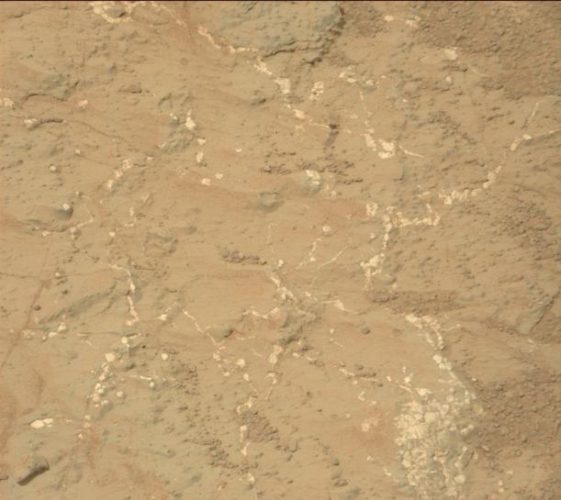
Some mineral veins in Gale Crater (Photo NASA/JPL-Caltech/MSSS)

An article published in the journal “Meteoritics & Planetary Science” describes a research on the ancient lake that existed in today’s Gale Crater on Mars. Scientists at the Open University and the University of Leicester used data collected by NASA’s Mars Rover Curiosity to understand the old conditions in Gale Crater concluding that the environment was similar to the Earth and in favor of the presence of life forms.

The Mars Rover Curiosity in the area of the Buckskin rock (Photo NASA/JPL-Caltech/MSSS)

An article published in the journal “Proceedings of the National Academy of Sciences” (PNAS) describes the unexpected discovery of a mineral called tridymite by the Mars Rover Curiosity in Gale Crater on Mars. The analysis of a sample from a rock called Buckskin revealed the presence of tridymite, which on Earth forms as a result of much more intense volcanic activity than that assumed esisted in the past on Mars.