Landers / Rovers

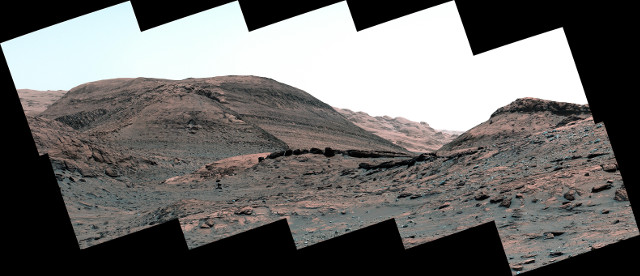
The "Wildcat Ridge" outcrop on Mars (Image NASA/JPL-Caltech/ASU/MSSS)

NASA’s Mars Rover Perseverance collected rock samples in an outcrop that was named “Wildcat Ridge” in the Jezero Crater on Mars. The analyzes show a geological variety that includes a mudstone that contains organic compounds. These results indicate that the rocks in that area are very different from those found on the crater floor, which were igneous rocks that form underground from volcanic magma and on the surface during volcanic activity. These are very interesting samples considering the mission in the design phase that will aim to bring them back to Earth to conduct in-depth analyzes.

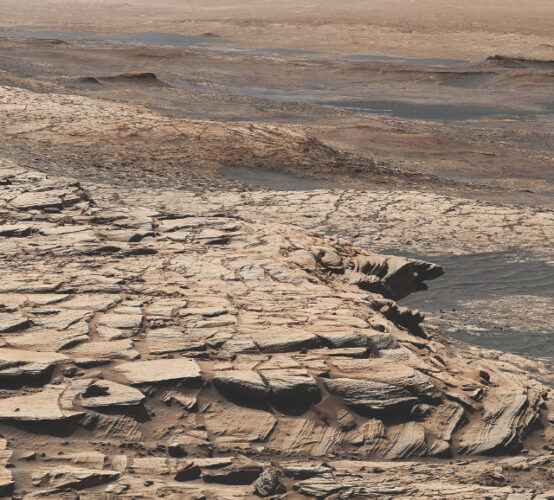
An area of Gale Crater (Image NASA/JPL-Caltech/MSSS)

NASA has released the results of data analysis recently collected by its Mars Rover Curiosity during its ascent of Mount Sharp on Mars. After spending years in areas of Gale Crater that surround the zone where there were still many traces of the ancient presence of water, Curiosity started traveling in a transition zone from a clay-rich region to one full of sulfate salt. The interest in that area is given by the fact that it shows the traces of the great climatic changes that transformed a planet that, when it was young, was similar to the Earth into today’s red planet.

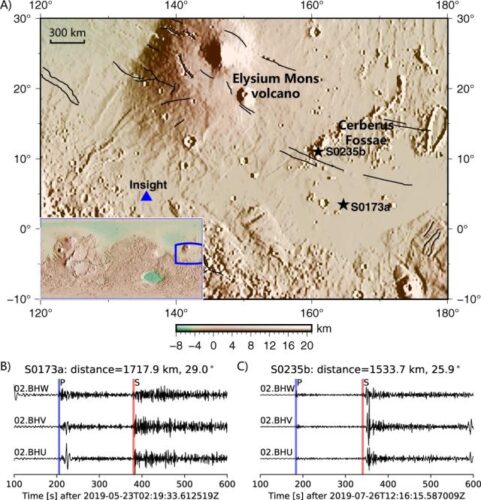
Map of the major marsquakes detected by the InSight lander

An article published in the journal “Nature Communications” reports a study that offers evidence that the marsquakes detected by NASA’s InSight lander are caused by the activity of underground volcanic magma. Doctor Weijia Sun of the Chinese Academy of Sciences and Professor Hrvoje Tkalčić of the Australian National University examined data collected by InSight identifying 47 underground marsquakes in the Cerberus Fossae region of Mars over the course of 350 Martian days. According to the two researchers, the Martian mantle is still active and the marsquakes are of volcanic origin and not tectonic, as the scientists who studied Mars believed.

The Stimson formation on Mars (Image NASA/Caltech-JPL/MSSS)

An article published in the journal “Proceedings of the National Academy of Sciences” reports the detection of samples rich in carbon-12, which on Earth is associated with biological processes, in Gale crater on Mars by NASA’s Mars Rover Curiosity. A team of researchers used the TLS instrument, part of Curiosity’s SAM mini-laboratory, to analyze the samples to check the amount of isotopes as well. The result is a limited presence in some samples of carbon-13 compared to that detectable in the atmosphere and in Martian meteorites. On Earth, such a result indicates that the sample was produced by some biological process. However, the researchers also offered alternative explanations related to non-biological processes.

The Rochette rock (Image NASA/JPL-Caltech)

NASA has published the first results of the examination of the first two rock samples collected in recent days by the Mars Rover Perseverance in the Jezero crater on planet Mars. After last month’s disappointment, with the failure of the first attempt to take a sample of a rock that proved too crumbly, there were two successes. A rock nicknamed Rochette proved suitable and Perseverance was successful in taking a sample nicknamed Montdenier on September 6 and a sample nicknamed Montagnac on September 8. The most interesting indication is that there was water in the area for a long time when the environment was potentially habitable.