Satellites

IS-901 seen by MEV-1

Intelsat and Northrop Grumman have announced that the communications satellite Intelsat 901 (IS-901) has returned to active service after the Mission Extension Vehicle 1 (MEV-1) spacecraft docked on February 25, 2020. MEV-1 will allow Intelsat 901 to maintain its orbit and attitude again for almost 5 years, extending its life. It’s the first time that a satellite has returned to activity thanks to this type of mission.

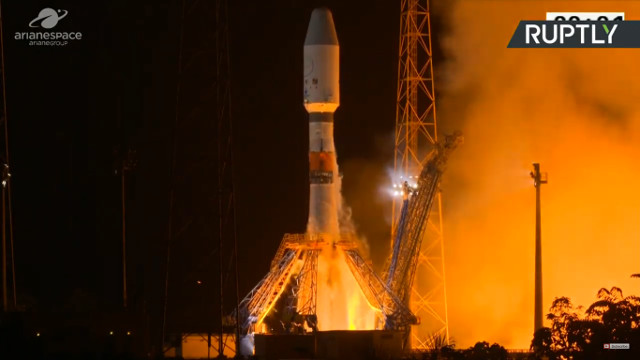
CHEOPS and Cosmo-SkyMed Second Generation blasting off atop aSoyuz rocket (Image courtesy Arianespace)

A few hours ago a Soyuz rocket was launched from the Kourou base, in French Guiana. After about 23 minutes the Cosmo-SkyMed Second Generation satellite successfully separated from the rocket’s Fregat last stage. About 85 minutes after the launch, the CHEOPS space telescope successfully separated from the rocket’s Fregat last stage.

The COSMO-SkyMed Second Generation satellite is the first of a constellation of two satellites that aims to replace the first generation’s four satellites. It’s a system of radar satellites for the territory observation, the result of a collaboration between the Italian Space Agency and the Italian Ministry of Defense.

The purpose of ESA’s CHEOPS (Characterizing ExOPlanets Satellite) space telescope is to conduct follow-up study of exoplanets using the transit method, which means observing the ones that pass in front of their star.

60 Starlink satellites blasting off atop a Falcon 9 rocket (Image courtesy SpaceX)

A little while ago 60 satellites of the Starlink constellation were launched on a Falcon 9 rocket from Cape Canaveral. After about an hour they were successfully deployed into their orbit at an altitude of about 280 kilometers all together and then started slowly disperse. This is SpaceX’s second mission to put the Starlink constellation into orbit to provide a global Internet connection coverage.

The L-1011 Stargazer aircraft taking off with the ICON satellite (Photo NASA/Frank Michaux)

A few hours ago the ICON (Interface Region Imaging Spectrograph) satellite was launched using a Pegasus XL rocket by Northrop Grumman brought to an altitude of about 11,900 meters by an L-1011 airplane, also by Northrop Grumman, modified for this purpose. After a little more than 11 minutes, ICON was brought into a low Earth orbit at an altitude of about 575 kilometers, where the solar panels regularly deployed and sent the first signals.

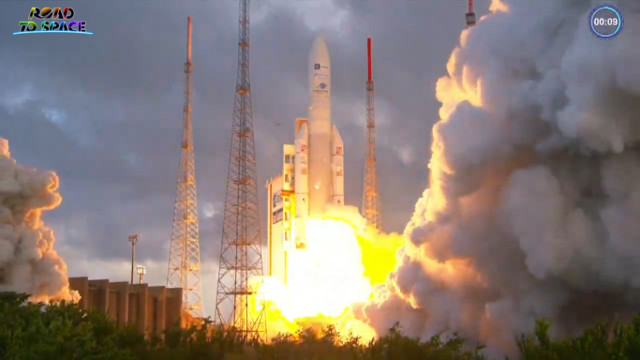
The Falcon Eye 1 satellite blasting off atop a Vega rocket (Image courtesy Arianespace. All rights reserved)

A few hours ago a Vega rocket was launched from the Kourou base, in French Guiana, to deploy the United Arab Emirates’ Falcon Eye 1 satellite. About two minutes after the launch, immediately after what was supposed to be the second stage’s ignition there was an anomaly that caused the mission’s failure. This is the first failure for the Vega rocket after 14 successes.