Space Stations

The Prichal module docked with the International Space Station (Image NASA TV)

Yesterday, the Russian Prichal module, also known as Uzlovoy Module (UM), docked with the International Space Station’s Nauka/MLM module becoming part of the Russian section. Prichal was launched on November 24 and flown to the Station by a modified Progress cargo spacecraft. Once the task to make it fully operational is completed, it will provide five more docking hatches.

The Prichal module blasting off atop a Soyuz 2.1b rocket (Photo courtesy RSC Energia)

Yesterday, the Russian Prichal module, also known as Uzlovoy Module (UL), was launched atop a Soyuz 2.1b rocket from the Baikonur Cosmodrome, Kazakhstan. After a little more than nine minutes, it successfully separated from the rocket’s last stage and set off on its course. Its journey will take just over two days to reach the International Space Station, on November 26, where it will become part of the Russian section many years behind schedule. Prichal will be driven to its destination by a modified Progress cargo spacecraft.

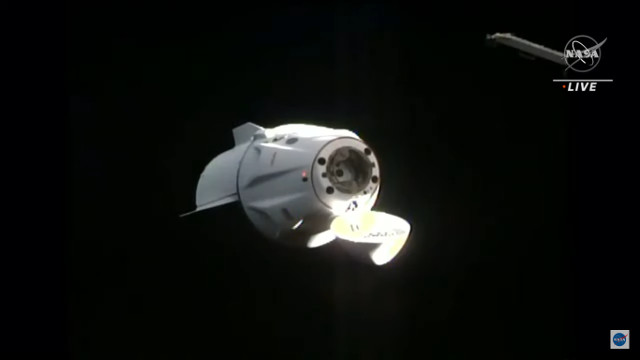
The Crew Dragon Endurance spacecraft approaching the International Space Station (Image NASA TV)

A few hours ago, SpaceX’s Crew Dragon Endurance spacecraft docked to the International Space Station’s Harmony module completing the first part of its Crew-3 or SpaceX Crew-3 mission that began yesterday with its launch. After checking that the pressure is correctly balanced, the hatch will be opened to allow Raja Chari, Thomas Mashburn, Matthias Maurer, and Kayla Barron to enter the Station. The Endurance reached the Station about 40 minutes earlier than the original schedule.

The launch of the Shenzhou 13 mission (Photo courtesy Xinhua)

A confirmation has arrived that the three Chinese taikonauts of the Shenzhou 13 mission have reached the Chinese space station’s Tianhe core module with an automated docking maneuver. They blasted off about six and a half hours earlier on a Long March-2F rocket from the Jiuquan Satellite Launch Center. They’re the second crew of the Chinese space station and will remain there for about six months, twice the length of the Shenzhou 12 mission.