Space Stations

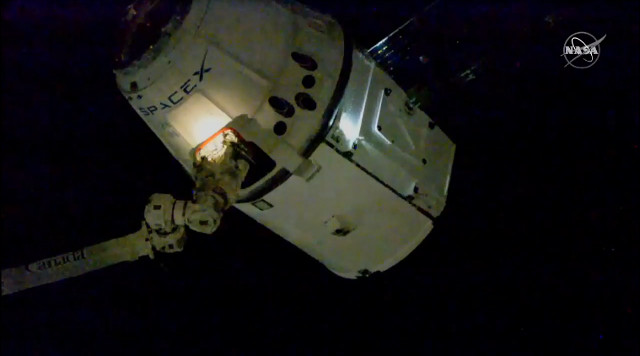
The HTV-8 cargo spacecraft captured by the International Space Station's Canadarm2 robotic arm (Image NASA TV)

A little while ago the HTV-8 “Kounotori” spacecraft was captured by the International Space Station’s Canadarm2 robotic arm, operated by Christina Koch with the assistance of Andrew Morgan. The Japanese space cargo ship, which blasted off last Tuesday, carries a huge amount of supplies and experiments. After its capture, the HTV-8 got slowly moved to its berthing location on the Harmony module, where it was safely installed.

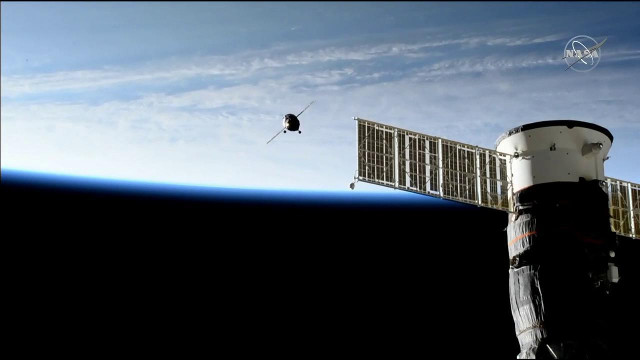
The Soyuz MS-14 spacecraft approaching the International Space Station. In the foreground the Soyuz MS-13 (Image NASA TV)

A few hours ago the Soyuz MS-14 spacecraft, which blasted off about last Wednesday from the Baikonur Cosmodrome in Kazakhstan, has reached the International Space Station. The integration test with the Soyuz 2.1a rocket was successful and the spacecraft reached its destination, even if it’s a few days late after the first docking attempt had to be aborted.

The Soyuz MS-14 spacecraft during its docking attempt (Image NASA)

A few hours ago the Soyuz MS-14 spacecraft, which blasted off about two days ago from the Baikonur Cosmodrome in Kazakhstan, attempted to dock with the International Space Station but a communications problem forced to abort the maneuver. Cosmonauts Alexey Ovchinin and Alexander Skvortsov are working together with the Russian space agency Roscosmos to retry the docking on Monday while the Soyuz MS-14 remains at a safe distance.

The Progress MS-12 cargo spacecraft approaching the International Space Station (Image NASA TV)

A few hours ago the Progress MS-12 spacecraft blasted off atop a Soyuz 2.1a rocket from the Baikonur Cosmodrome in Kazakhstan. After about nine minutes it successfully separated from the rocket’s last stage and was placed on its ultra-fast track in its resupply mission to the International Space Station also called Progress 73 or 73P. After almost 3.5 hours it reached the International Space Station docking with its Pirs module.