Space Stations

The Progress MS-25 cargo spacecraft approaching the International Space Station (Image NASA TV)

A little while ago, the Progress MS-25 spacecraft docked with the International Space Station in the mission also referred to as Progress 85 or 85P. The Russian cargo spacecraft, which blasted off last Friday, December 1, carries food, water, scientific experiments, fuel, and various hardware. The Progress spacecraft have an automatic docking system but in case of problems, the cosmonauts on board the Station take control of it and that’s what happened today to complete the maneuver.

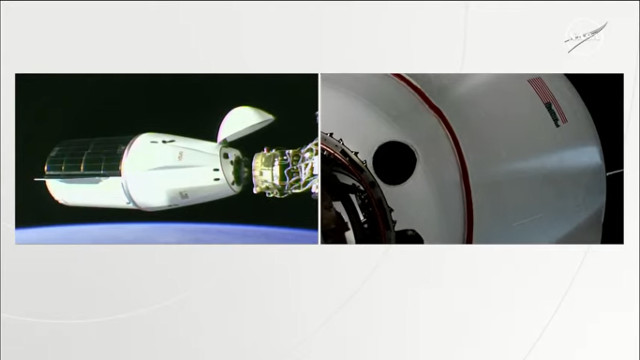
The Dragon 2 cargo spacecraft docking with the International Space Station in its CRS-29 mission (Image NASA TV)

A little while ago, SpaceX’s Dragon 2 spacecraft docked with the International Space Station’s Harmony module completing the first part of its CRS-29 mission. Astronauts Jasmin Moghbeli and Loral O’Hara monitored the operation but the cargo spacecraft, which blasted off when it was Thursday night in the USA, completed the maneuvers automatically without any problem.

The CRS-29 mission will end in about a month with the return to Earth. The second version of the Dragon cargo spacecraft can stay in space much longer than the first version but for now, NASA hasn’t extended its missions.

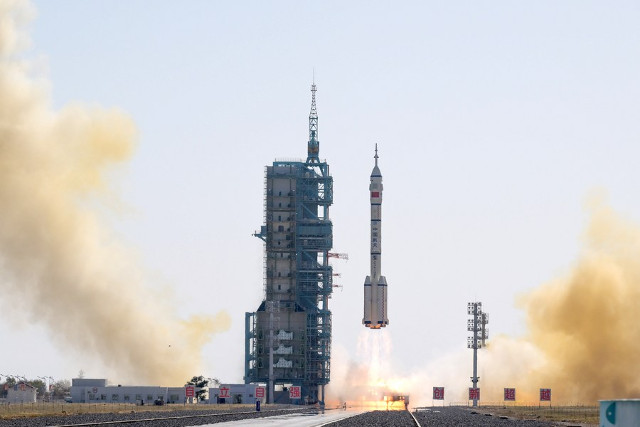
The Shenzhou 17 spacecraft blasting off (Photo courtesy Li Zhipeng)

A confirmation has arrived that three Chinese taikonauts from the Shenzhou 17 mission reached the Chinese space station Tiangong with an automated docking maneuver. They blasted off about 6.5 hours earlier atop a Long March-2F rocket from the Jiuquan Satellite Launch Center. They form the sixth crew of the Chinese space station and will remain there for about six months, the standard duration for a mission.

The three taikonauts, as the Chinese call their astronauts, of the Shenzhou 17 mission are Tang Hongbo, Tang Shengjie and Jiang Xinlin, whose names were announced only the day before the launch, as is customary for the Chinese.

The Soyuz MS-24 spacecraft blasting off atop a Soyuz-2.1a rocket (Image NASA TV)

A few hours ago, the Soyuz MS-24 spacecraft was launched from the Baikonur Cosmodrome in Kazakhstan and after a little more than three hours reached the International Space Station with three new crew members on board. It docked with the Station’s Rassvet module. As is becoming increasingly common for crewed trips as well, the ultra-fast track was used which halves the journey duration.

Oleg Kononenko and Nikolai Chub will spend about a year on the International Space Station while Loral O’Hara will spend about six months there and return to Earth with different traveling companions. Expedition 69 is almost over, as in less than two weeks, the crew members who’ve been on the Station for a year will return to Earth marking the start of Expedition 70.

The Crew Dragon Endurance spacecraft approaching the International Space Station in its Crew-7 mission (Image NASA TV)

A little while ago, SpaceX’s Crew Dragon Endurance spacecraft docked with the Harmony module of the International Space Station completing the first part of its Crew-7 or SpaceX Crew-7 mission that began with its launch almost 30 hours earlier. After checking that the pressure gets properly balanced, the hatch will be opened to allow Jasmin Moghbeli, Andreas Mogensen, Satoshi Furukawa, and Konstantin Borisov to enter the Station and start their mission, which will last about six months.