Spacecraft

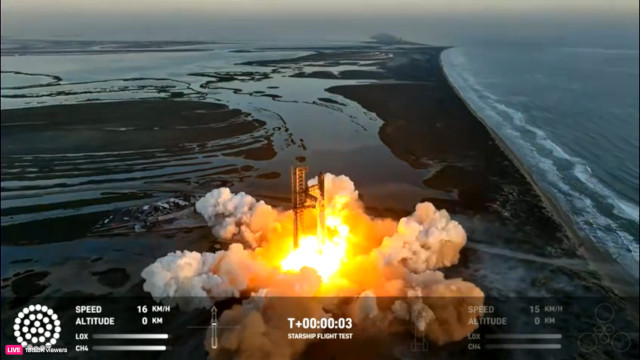
Super Heavy Booster 8 and Starship 25 blasting off (Image courtesy SpaceX)

SpaceX conducted a new flight test of its Super Heavy rocket and Starship prototypes, launched from its base in Boca Chica, Texas. This is the second test involving the entire system of Elon Musk’s company which is supposed to revolutionize space travel with an unprecedented transport capacity and being totally reusable. In this case, however, they are prototypes with the Super Heavy identified as Booster 9 and the Starship identified as Starship 25 or Ship25 or simply S25. Despite the upgrades, they don’t have the safety requirements required to conduct controlled landings. After the first test conducted on April 20, many changes were made to the Super Heavy and Starship systems but also to the launch pad.

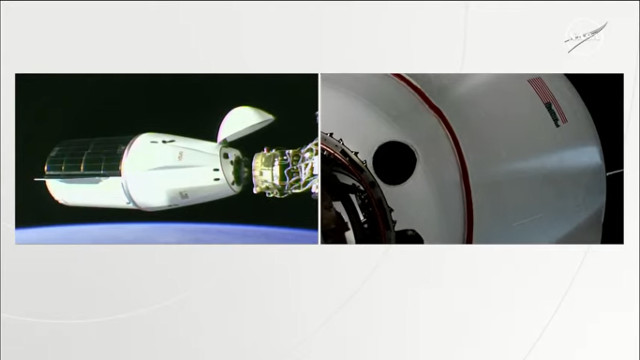
The Dragon 2 cargo spacecraft docking with the International Space Station in its CRS-29 mission (Image NASA TV)

A little while ago, SpaceX’s Dragon 2 spacecraft docked with the International Space Station’s Harmony module completing the first part of its CRS-29 mission. Astronauts Jasmin Moghbeli and Loral O’Hara monitored the operation but the cargo spacecraft, which blasted off when it was Thursday night in the USA, completed the maneuvers automatically without any problem.

The CRS-29 mission will end in about a month with the return to Earth. The second version of the Dragon cargo spacecraft can stay in space much longer than the first version but for now, NASA hasn’t extended its missions.

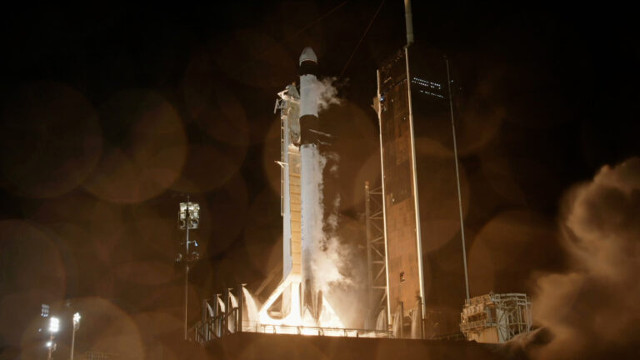
SpaceX Dragon 2 cargo spacecraft stars its CRS-29 mission blasting off atop a Falcon 9 rocket (Photo NASA)

A few hours ago, the SpaceX Dragon 2 spacecraft blasted off atop a Falcon 9 rocket from the Kennedy Space Center in its CRS-29 (Cargo Resupply Service 29) mission, also referred to as SPX-29. After almost exactly 12 minutes it separated successfully from the rocket’s last stage and went en route. This is the 29th mission for the Dragon/Dragon 2 spacecraft to resupply the International Space Station with various cargoes and then return to Earth, again with various cargoes.

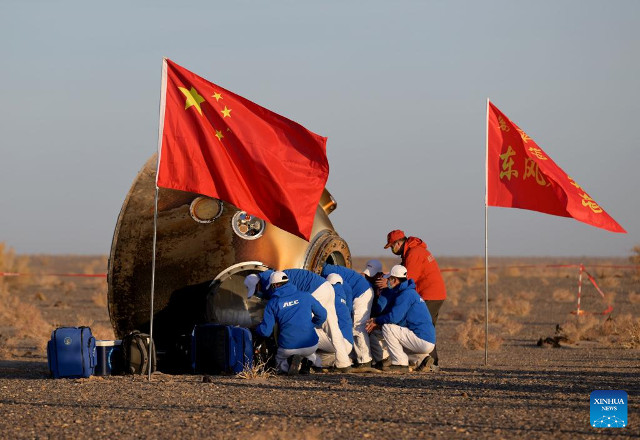
The Shenzhou 16 capsule after landing (Photo courtesy Xinhua/Li Zhipeng)

Yesterday, the three Chinese taikonauts of the Shenzhou 16 mission returned to Earth after spending 154 days on the Chinese Tiangong space station, landing at a site called Dongfeng in China’s Inner Mongolia Autonomous Region. During the capsule’s descent, some observers noticed a hole in the parachute. The speed of descent may have been faster than normal and the capsule toppled over after landing. It has already happened in the past that the capsule didn’t remain vertical and no consequences were reported for the taikonauts on board Gui Haichao, Jing Haipeng, and Zhu Yangzhu. In fact, there are no official communications regarding anomalies during the landing.

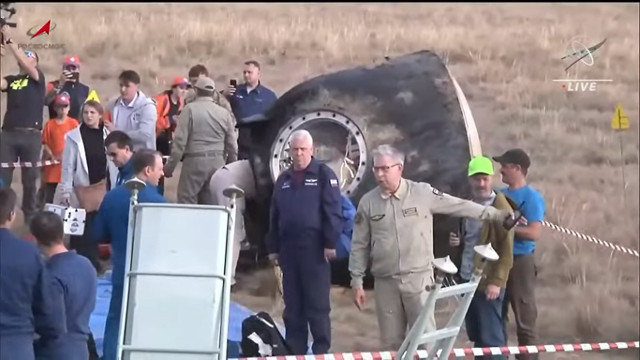
The Soyuz MS-23 Capsule after landing (Image NASA TV)

A little while ago, cosmonauts Sergey Prokopyev and Dmitri Petelin and astronaut Frank Rubio returned to Earth on the Soyuz MS-23 spacecraft, which landed in Kazakhstan. They spent just over one year on the International Space Station, where they arrived on September 21, 2022, as part of Expedition 67. According to the original schedule, they were supposed to spend about six months on the Station but the failure of the Soyuz MS-22 spacecraft led to to double their mission’s duration.