Spacecraft

The Crew Dragon Freedom spacecraft blasting off to begin the Ax-3 mission (Image courtesy Axiom Space)

A few hours ago, SpaceX’s Crew Dragon Freedom spacecraft was launched atop a Falcon 9 rocket from the Kennedy Space Center on the Axiom Mission 3, or simply Ax-3, mission. After about twelve minutes, it successfully separated from the rocket’s last stage. It will spend about 14 days in orbit, almost all of which will be docked at the International Space Station. It also serves commercial purposes in a collaboration between SpaceX, Axiom Space, and various companies and national space agencies to access the Station for the purpose of conducting tasks useful for the development of new technologies and for scientific research.

The Dragon cargo spacecraft departing the International Space Station to end its CRS-29 mission (Image NASA TV)

A few hours ago, SpaceX’s Dragon spacecraft ended its CRS-29 (Cargo Resupply Service 29) mission for NASA splashing down smoothly off the Florida Coast. The Dragon left the International Space Station a little more than 19 hours earlier. For SpaceX, this was the 9th mission of the 2nd contract with NASA to transport supplies to the Station with the new version of the Dragon cargo spacecraft.

Shortly after the splashdown, SpaceX’s recovery ship went to retrieve the Dragon to transport it to the coast. The cargo brought back to Earth will be delivered to NASA within a few hours. The Dragon spacecraft reached the International Space Station on November 11, 2023.

The Progress MS-25 cargo spacecraft approaching the International Space Station (Image NASA TV)

A little while ago, the Progress MS-25 spacecraft docked with the International Space Station in the mission also referred to as Progress 85 or 85P. The Russian cargo spacecraft, which blasted off last Friday, December 1, carries food, water, scientific experiments, fuel, and various hardware. The Progress spacecraft have an automatic docking system but in case of problems, the cosmonauts on board the Station take control of it and that’s what happened today to complete the maneuver.

The Progress MS-25 cargo spacecraft blasting off atop a Soyuz-2.1a rocket (Image NASA TV)

A little while ago, the Progress MS-25 spacecraft blasted off atop a Soyuz-2.1a rocket from the Baikonur Cosmodrome in Kazakhstan. After about nine minutes it successfully separated from the rocket’s last stage and was placed on its route. The cargo spacecraft began its resupply mission to the International Space Station also called Progress 85 or 85P. In this mission, the route used is the one that requires about two days.

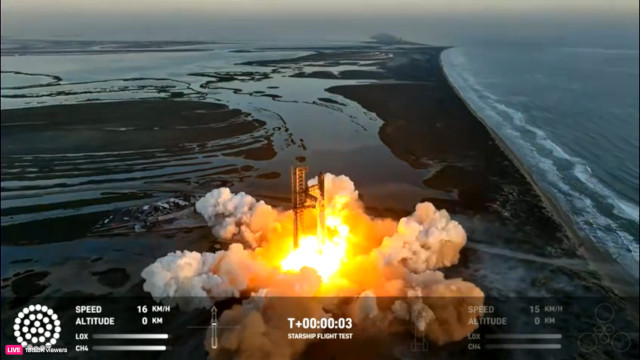
Super Heavy Booster 8 and Starship 25 blasting off (Image courtesy SpaceX)

SpaceX conducted a new flight test of its Super Heavy rocket and Starship prototypes, launched from its base in Boca Chica, Texas. This is the second test involving the entire system of Elon Musk’s company which is supposed to revolutionize space travel with an unprecedented transport capacity and being totally reusable. In this case, however, they are prototypes with the Super Heavy identified as Booster 9 and the Starship identified as Starship 25 or Ship25 or simply S25. Despite the upgrades, they don’t have the safety requirements required to conduct controlled landings. After the first test conducted on April 20, many changes were made to the Super Heavy and Starship systems but also to the launch pad.