Spacecraft

Starship SN8 blasting off (Image courtesy SpaceX)

It was afternoon in the USA when SpaceX conducted the first flight test of a prototype of Starship, the one identified as SN8, in Boca Chica, Texas. Equipped with 3 Raptor engines, SN8 flew regularly up to an altitude of approximately 12.5 kilometers, then attempted a controlled landing at the end of a series of maneuvers. During the ascent it remained in a vertical position while during the descent it carried out various maneuvers that brought it to a horizontal position almost to the ground, where it turned over. However, after 6 minutes and 42 seconds of flight, SN8 landed too fast and was consequently destroyed. Despite the ending, the test was in many ways really positive.

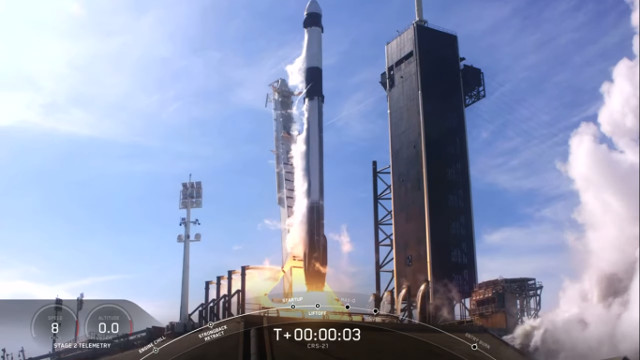
SpaceX's Dragon 2 spacecraft blasting off atop a Falcon 9 rocket (Image courtesy SpaceX)

A little while ago the SpaceX Dragon 2 spacecraft blasted off atop a Falcon 9 rocket from Cape Canaveral in its CRS-21 (Cargo Resupply Service 21) mission, also referred to as SPX-21. After just over eleven minutes it separated successfully from the rocket’s last stage and went en route. This is the 21st mission for the Dragon spacecraft to resupply the International Space Station with various cargoes and then return to Earth, again with various cargoes. It’s the first mission for this Dragon version.

The Moon's surface seen by the Chang'e-5's lander, including its shadow (Photo courtesy China National Space Administration/CLEP)

It was night in China when the lander and ascent vehicle of the Chinese Chang’e-5 mission successfully completed their Moon landing maneuvers. The various modules that make up Chang’e-5 were launched when it was November 24 in China and reached the Moon’s orbit in recent days. At that point, a series of maneuvers begun to make its orbit circular, the modules that were scheduled to land separated, and everything went well. Very soon, the lander was scheduled to begin its excavation work to collect soil and subsoil samples that will be sent into orbit to be returned to Earth around mid-December.