Spacecraft

The HTV-9 spacecraft blasting off atop a H-IIB rocket (Image courtesy JAXA)

A little while ago the HTV-9 spacecraft blasted off atop a H-IIB rocket from the Tanegashima space center in Japan for a resupply mission to the International Space Station. About fifteen minutes after the launch, the cargo spacecraft separated regularly from the rocket’s last stage, entered its preliminary orbit and deployed its solar panels and navigation antennas.

The Moon landers by Dynetics, SpaceX and Blue Origin / National Team

NASA has announced the choice of three companies to design and develop human landing systems for the Artemis program. These are essentially plans for a lunar lander among which one will be selected to be built for the mission that, according to plans, is supposed to bring American astronauts back to the Moon by 2024. The companies selected are Blue Origin (actually the first contractor for a group called National Team), Dynetics, and SpaceX. This stage of development involves a 10-month base period during which companies and NASA will work together on the selected projects. The total contract value is $967 million.

The Progress MS-14 cargo spacecraft blasting off atop a Soyuz 2.1a rocket (Image NASA TV)

A few hours ago the Progress MS-14 spacecraft blasted off atop a Soyuz 2.1a rocket from the Baikonur Cosmodrome in Kazakhstan. After about nine minutes it successfully separated from the rocket’s last stage and was placed on its ultra-fast track in its resupply mission to the International Space Station also called Progress 75 or 75P. After almost 3.5 hours it reached the International Space Station docking with its Zvezda module.

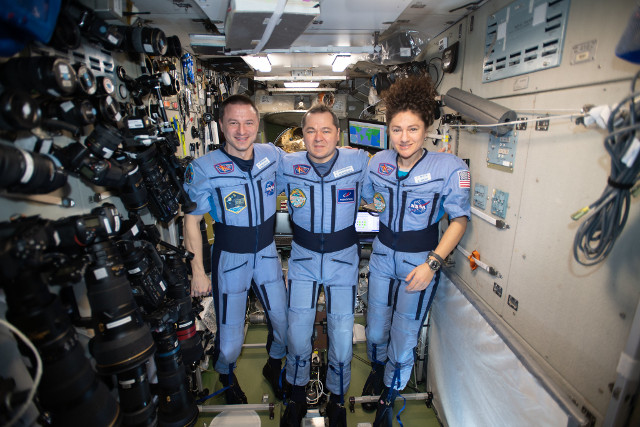
Andrew Morgan, Oleg Skripochka and Jessica Meir (Photo NASA)

A little while ago astronauts Jessica Meir and Andrew Morgan and cosmonaut Oleg Skripochka returned to Earth on the Soyuz MS-15 spacecraft, that landed in Kazakhstan. The three of them spent a bit more than 6 months on the International Space Station, where they arrived on September 25, 2019 as part of Expedition 61. After landing, they were assisted by a skeleton crew with the precautions needed to avoid the risk of Covid-19 infection.

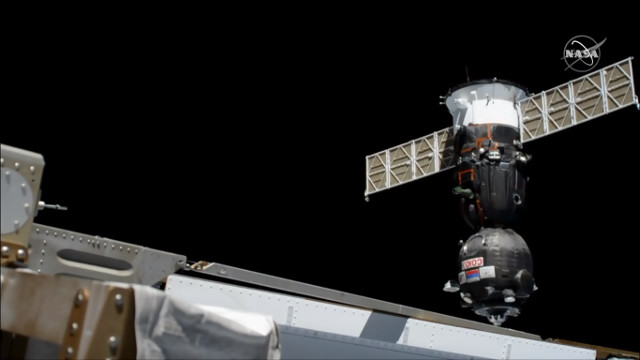
The Soyuz MS-16 spacecraft docking with the International Space Station (Image NASA TV)

A little while ago the Soyuz MS-16 spacecraft was launched from the Baikonur Cosmodrome in Kazakhstan and after a little more than six hours reached the International Space Station with three astronauts on board. In the period preceding a launch, it’s normal for astronauts and cosmonauts to remain in quarantine. In this case it was also extended to the personnel who managed the launch, with limits to the people who could have been in Baikonur.