Spacecraft

Christina Koch, Alexander Skvortsov and Luca Parmitano assisted after their landing (Image NASA TV)

A little while ago astronauts Luca Parmitano and Christina Koch and cosmonaut Alexander Skvortsov returned to Earth on the Soyuz MS-13 spacecraft, that landed in Kazakhstan. Parmitano and Skvortsov spent a bit more than 6 months on the International Space Station, where they arrived on July 20, 2019 as part of Expedition 60, while Christina Koch arrived on March 15, 2019 as part of Expedition 59 and accomplished a long mission.

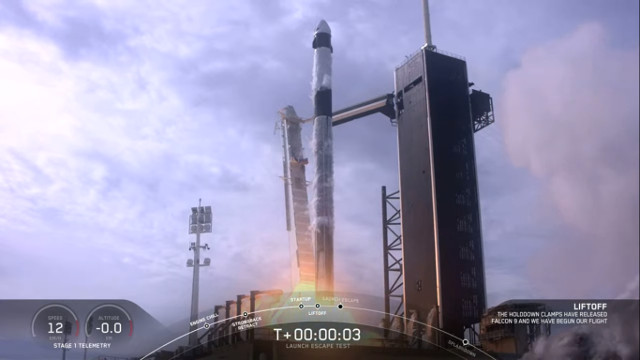
La navicella spaziale Crew Dragon al decollo per il test di interruzione d'emergenza del lancio (Immagine cortesia SpaceX)

SpaceX has just completed the In-Flight Abort Test of one of its Crew Dragon spacecraft, the version of Dragon 2 produced for the transport of astronauts. A Falcon 9 rocket was deliberately blown up at the moment of maximum dynamic pressure, Max q in jargon, to test that the the systems which in a normal launch are used to rescue the crew aboard the Crew Dragon work properly.

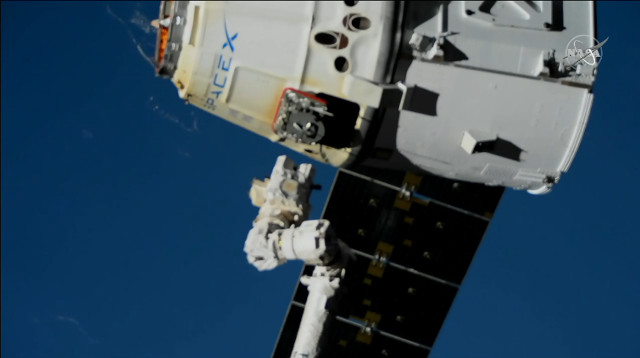
The Dragon cargo spacecraft leaving the International Space Station to end its CRS-19 mission (Image NASA TV)

A little while ago the SpaceX Dragon spacecraft ended its CRS-19 (Cargo Resupply Service 19) mission for NASA splashing down smoothly in the Pacific Ocean almost 500 kilometers (about 300 miles) off the coast of California. The Dragon left the International Space Station a few hours earlier.

Shortly after landing, SpaceX boats went to retrieve the Dragon to transport it to the coast. The cargo brought back to Earth will be delivered to NASA soon, probably tomorrow. The Dragon spacecraft reached the International Space Station on December 8, 2019.

Boeing's CST-100 Starliner Calypso spacecraft during recovery (Photo courtesy Boeing. All rights reserved)

Boeing has announced that its engineers and technicians are conducting an in-depth examination of its CST-100 Starliner spacecraft, which landed on December 22 after the premature end of its Boe-OFT (Boeing Orbital Flight Test) mission. The exam includes the recovery of all the data recorded by the on-board systems to obtain final answers on the problem that caused an off-nominal orbit insertion about half an hour after launch. After landing at the White Sands Missile Range, New Mexico, the name Calypso was proposed by astronaut Sunita Williams and quickly approved, therefore it will be the official name used in the next missions, as the spacecraft is reusable.

Boeing's CST-100 Starliner spacecraft landing (Image NASA TV)

A little while ago Boeing’s CST-100 Starliner spacecraft landed at the White Sands Missile Range in New Mexico, ending its Boe-OFT (Boeing Orbital Flight Test) mission. Unlike the previous American spacecraft, this one doesn’t splash down in the ocean but lands on the ground. The ground staff intervened in an exercise of the assistance activity that will take place in manned missions.