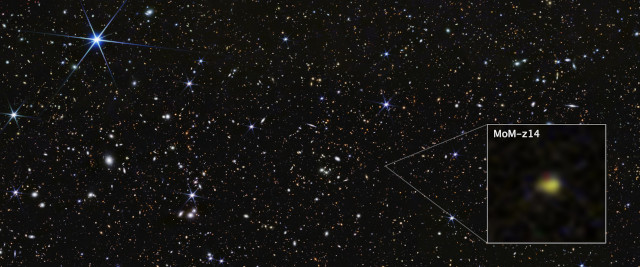
The galaxy MoM-z14 photographed by the James Webb Space Telescope's NIRCam (Near-Infrared Camera) instrument with an image from the so-called COSMOS Legacy Field in the background.

An article accepted for publication in the “Open Journal of Astrophysics” reports evidence that the galaxy MoM-z14 is the most distant known so far. A team of researchers led by the Kavli Institute for Astrophysics and Space Research at the Massachusetts Institute of Technology (MIT) used the James Webb Space Telescope as part of the “Mirage or Miracle” (MoM) survey, in which the NIRSpec instrument was used to verify the nature of very bright and potentially very distant galaxies observed in images captured by the NIRCam instrument. The results confirm that we see MoM-z14 as it was about 280 million years after the Big Bang, confirming again that highly active galaxies existed at that time.

A graph with the conservative habitable zone illustrated by the orange band and ellipses illustrating the extended habitable zone proposed by this study

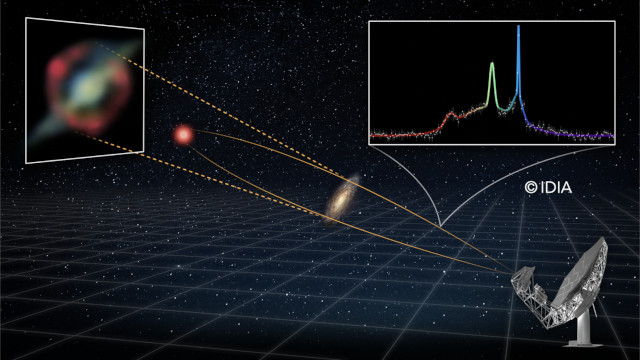
An article published in “The Astrophysical Journal” reports the results of a study on the habitable zone that goes beyond the so-called conservative zone because it’s based on rigid assumptions. Astrophysicist Amri Wandel of the Hebrew University of Jerusalem focused on examining the conditions existing in systems of low-mass stars: orange dwarfs (K-class stars) and red dwarfs (M-class stars). The study specifically considered planets tidally locked to their stars.

Amri Wandel conducted an analysis using climate models that account for global heat transport, the greenhouse effect, and albedo. This led him to conclude that these stars may host planets potentially habitable for Earth-like life forms orbiting outside the conservative habitable zone.

The Shenzhou 20 spacecraft's capsule after landing (Photo courtesy Xinhua/Li Zhipeng)

A few hours ago, the Shenzhou 20 spacecraft landed after spending 270 days docked at the Chinese Tiangong space station, where it arrived on April 24, 2025, carrying three taikonauts: Chen Dong, Chen Zhongrui, and Wang Jie. The Shenzhou 20 departed the station about nine hours earlier and landed at a site called Dongfeng in China’s Inner Mongolia Autonomous Region. The three taikonauts returned to Earth on November 14, 2025, aboard the Shenzhou 21 spacecraft because the Shenzhou 20 suffered small fractures to a window following the impact of what was likely space debris and was deemed unsafe for human transport. Despite this, the preliminary inspection showed that the Shenzhou 20 is generally in good condition.

The Crew Dragon Endeavour spacecraft recovered at the end of its Crew-11 mission (Image NASA)

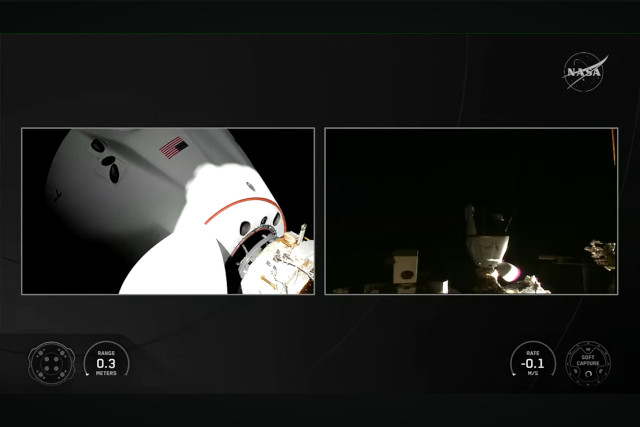
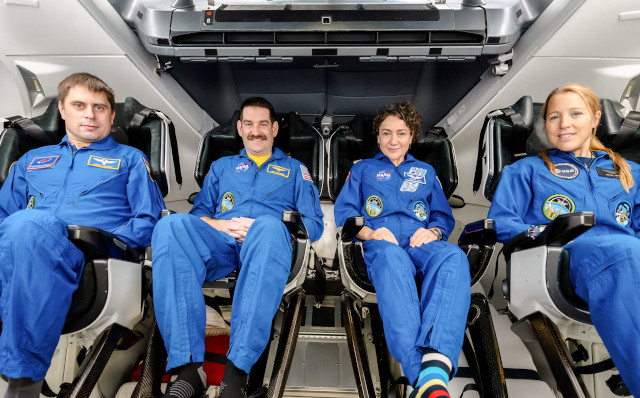
A little while ago, SpaceX’s Crew Dragon Endeavour spacecraft completed its Crew-11, or SpaceX Crew-11, mission for NASA with a successful splashdown. Aboard were astronauts Zena Cardman, Michael Fincke, and Kimiya Yui, and cosmonaut Oleg Platonov, who had arrived at the International Space Station on August 2, 2025, as part of Expedition 73/74. The Crew-11 members ended SpaceX’s 11th regular crewed mission in the Pacific Ocean, off the coast of California. The Crew Dragon had left the Station approximately 11 hours earlier.

The Crew-11 mission ended a few weeks early in what was described as a medical evacuation due to a medical condition affecting one of the crew members. For privacy reasons, no details were released, starting from the identity of the person who’s suffering the health issue.

A Falcon 9 rocket lifting off on the Twilight rideshare mission (Image courtesy SpaceX)

A few hours ago, a Falcon 9 rocket launched from Vandenberg Air Force Base on the Twilight rideshare mission, carrying a total of 40 satellites in various phases. About two hours and twenty minutes after launch, the final group of satellites was deployed by SpaceX’s system. Among them were NASA’s Pandora Space Telescope and the BlackCAT and SPARCS nanosatellites, both 30x20x10-centimeter CubeSat-class satellites, part of NASA’s CubeSat Launch Initiative. These satellites will conduct their astronomical observations from low-Earth orbit.