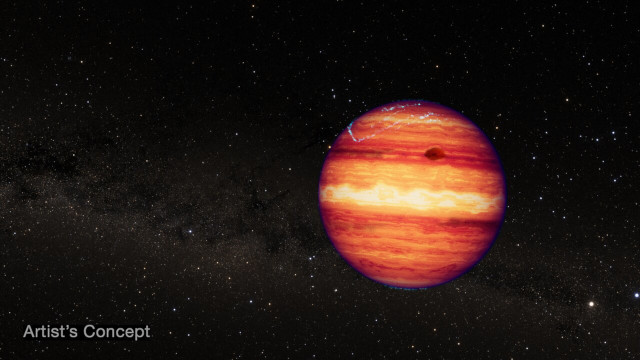
Artist’s concept of SIMP 0136 (Image NASA, ESA, CSA, J. Olmsted (STScI))

An article published in “The Astrophysical Journal Letters” reports the results of a study of the super-Jupiter object cataloged as SIMP J013656.5+093347.3 and referred to as SIMP J0136+09 or simply SIMP 0136. A team of researchers used observations conducted with the James Webb Space Telescope to monitor the infrared emissions from this object. Its nature is still undetermined because it has an estimated mass of around 13 times Jupiter’s, at the boundary between a planet and a brown dwarf. The result is the discovery of an atmosphere that varies quickly, probably due to layers of clouds with different chemical compositions.

Graphic representation of the Blue Ghost M1 lander on the Moon (Image courtesy NASA / Firefly Aerospace)

A little while ago, Firefly Aerospace’s Blue Ghost lander attempted a Moon landing in Mare Crisium. This was an autonomous maneuver that was the key step in what is known as Mission 1. After completing its braking and touching down on the Moon’s surface, Blue Ghost sent signals from its sensors confirming its success. After just over half an hour, it started sending images of the Moon’s surface.

The Nova-C Athena Moon lander and the Lunar Trailblazer satellite blasting off atop a Falcon 9 rocket (Image courtesy Intuitive Machines)

A few hours ago, the Nova-C Athena Moon lander blasted off atop a SpaceX Falcon 9 rocket from Kennedy Space Center on Intuitive Machines’ IM-2 mission. After about 48 minutes, it successfully separated from the rocket’s last stage and set off on a course to the Moon, where it’s scheduled to attempt a landing on March 6. About 3 minutes later, NASA’s small Lunar Trailblazer satellite also separated from the rocket’s second stage, but its course is very different from Athena’s, so it will not reach the Moon until June.

The Small Magellanic Cloud and the molecular coulds subject of this study

An article published in “The Astrophysical Journal” reports a study of 17 molecular clouds in the Small Magellanic Cloud, one of the Milky Way’s satellite dwarf galaxies. A team of researchers led by Kazuki Tokuda, a postdoctoral researcher at Kyushu University, Japan, examined high-resolution images captured using the ALMA radio telescope to obtain information on their characteristics. The examination showed that 40% of those clouds had a more diffused gas, with fluffy structures. The others were classic molecular clouds with a filamentary structure that are also found in the Milky Way. This difference was attributed to the scarcity of elements heavier than hydrogen and helium in the Small Magellanic Cloud, a situation similar to that of the early universe.

Mosaic of candidate active galactic nuclei in dwarf galaxie

An article to be published in “The Astrophysical Journal” reports the discovery of about 2,500 new candidate active galactic nuclei in dwarf galaxies and about 300 new candidate intermediate-mass black holes. A team of researchers examined observations conducted with the Dark Energy Spectroscopic Instrument (DESI) on the Nicholas U. Mayall 4-meter Telescope in Arizona to find all these possible black holes.