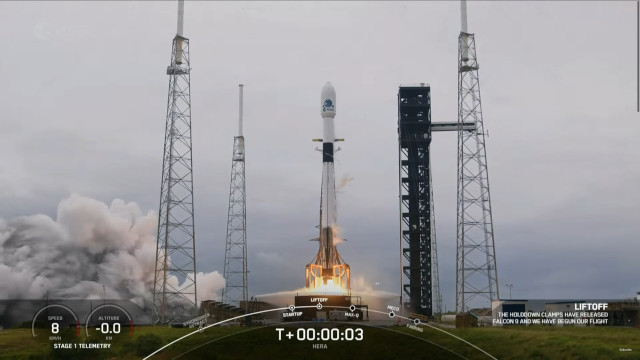
The Hera space probe blasting off atop a Falcon 9 rocket (Image courtesy SpaceX)

Yesterday, ESA’s Hera space probe blasted off atop a SpaceX Falcon 9 rocket from the Cape Canaveral together with the two nanosatellites Juventas and Milani. After about 76 minutes, it successfully separated from the rocket’s last stage and set on its course which in almost exactly two years will take it to the asteroid Didymos and its moon Dimorphos to examine the consequences of the impact of NASA’s DART spacecraft.

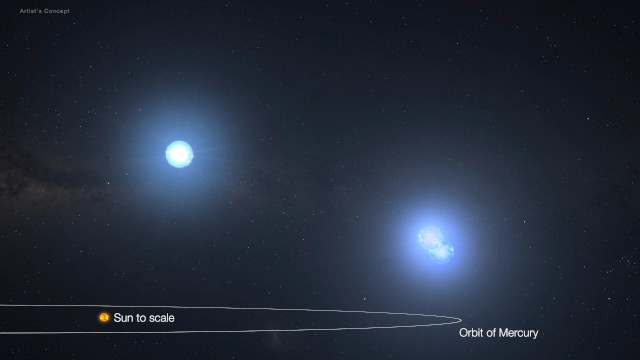
An illustration of the TIC 290061484 system with its three stars showing its compactness with a scale representation of the orbit of the planet Mercury in the solar system.

An article published in “The Astrophysical Journal” reports the discovery of the triple system cataloged as TIC 290061484, the most compact of its kind found so far. A team of researchers coordinated by NASA’s Goddard Space Flight Center used observations with NASA’s TESS space telescope, applied a machine learning technique, and involved citizen scientists who participated in the Planet Hunters project in a new project called the Visual Survey Group. This rare triple system will help astronomers better understand the processes of formation and evolution of multiple systems.

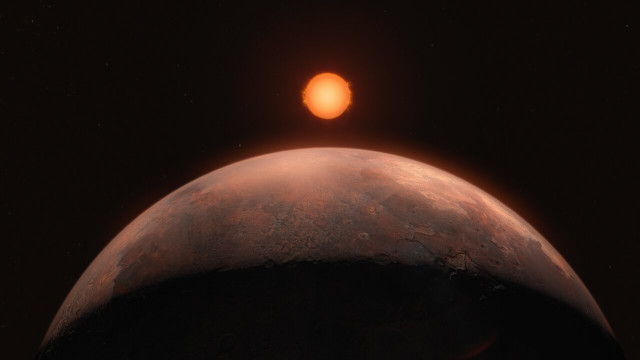
Artist’s impression of the exoplanet Barnard b with Barnard's Star in the background (Image ESO/M. Kornmesser)

An article published in the journal “Astronomy & Astrophysics” reports the identification of an exoplanet smaller than Earth orbiting Barnard’s Star. A team of researchers identified the exoplanet designated as Barnard b using the ESPRESSO instrument installed on ESO’s VLT in Chile. This discovery was later confirmed with other specialized exoplanet-hunting instruments: HARPS, HARPS-N, and CARMENES. The researchers also detected other signatures that suggest the presence of three exoplanet candidates, but follow-up investigations are needed to verify their existence.

The Crew Dragon Freedom spacecraft docked with the International Space Station in its Crew-9 mission (NASA TV)

A few hours ago, SpaceX’s Crew Dragon Freedom spacecraft docked with the Harmony module of the International Space Station completing the first part of its Crew-9 or SpaceX Crew-9 mission that began with its launch about 28 hours earlier. After checking that the pressure gets properly balanced, the hatch will be opened to allow Nick Hague and Aleksandr Gorbunov to enter the Station and start their mission, which will last about five months.

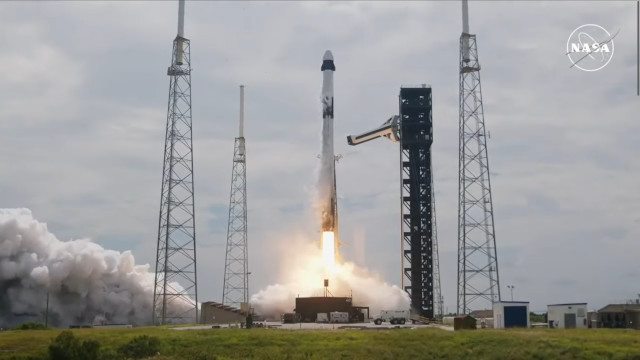
The Crew Dragon Freedom spacecraft blasting off atop a Falcon 9 rocket in its Crew-9 mission (Image NASA TV)

A little while ago, SpaceX’s Crew Dragon Freedom spacecraft blasted off atop a Falcon 9 rocket from the Kennedy Space Center in its Crew-9 or SpaceX Crew-9 mission. After almost exactly twelve minutes, it successfully separated from the rocket’s last stage and went en route to carry out its mission. This is the 9th crewed mission of the Crew Dragon spacecraft within the normal rotation of the International Space Station crew.