Possible Proxima Centauri orbit. The numbers are in millennia (Image P. Kervella (CNRS/U. of Chile/Observatoire de Paris/LESIA), ESO/Digitized Sky Survey 2, D. De Martin/M. Zamani)

An article published in the journal “Astronomy and Astrophysics” describes the observations that led to conclude that the star Proxima Centauri orbits Alpha Centauri A and B forming a triple system. Astronomers Pierre Kervella, Frederic Thevenin and Christophe Lovis used the HARPS instrument installed at ESO’s La Silla observatory in Chile to obtain the precise measurements needed to support this theory.

Some of the ancient galaxies observed (Image K. Trisupatsilp, NRAO/AUI/NSF, NASA)

An article published in “The Astrophysical Journal” describes the observations of the birthplaces of most of today’s stars. A team of astronomers led by Wiphu Rujopakam of the University of Tokyo and the Chulalongkorn University in Bangkok used the VLA and ALMA radio telescopes to study galaxies so far away that we see them as they were about 10 billion years ago, when in the universe there was a peak period of star formation.

VIPERS survey's map (Image B. Granett, L. Guzzo & the VIPERS Collaboration)

In recent days, two groups of researchers have published their cosmic maps. The VIPERS project used the VIMOS spectrograph installed on ESO’s VLT (Very Large Telescope) to examine 90,000 galaxies and create a wide and highly accurate three-dimensional map of the distant universe. The Pan-STARRS project used the telescope at Haleakala, Hawaii, to obtain repeated images of three-quarters of the visible sky and create a map of billions of space objects.

ALPHA experiment facility (Photo courtesy Maximilien Brice/CERN)

An article published in the journal “Nature” describes the measurement of a spectral line of an antihydrogen atom. The ALPHA experiment at CERN, which is specifically intended to conduct experiments on anti-hydrogen to better understand antimatter’s characteristics, managed to trap an anti-atom to examine it with a laser and to establish that its spectral characteristics are identical to those of hydrogen.

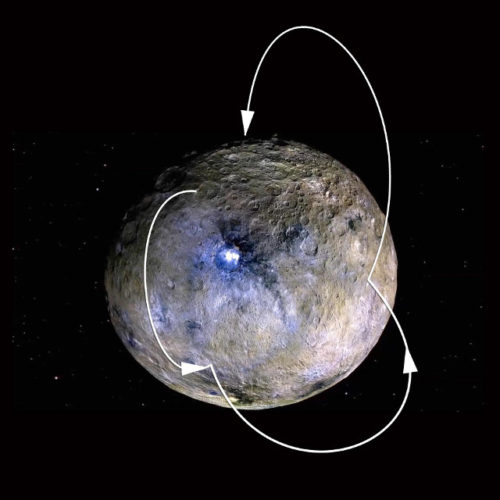
Scheme of water molecules falling into cold traps on Ceres (Image NASA/JPL-Caltech/UCLA/MPS/DLR/IDA)

Two articles published in the magazines “Science” and “Nature Astronomy” describe two studies also presented at the American Geophysical Union meeting taking place in San Francisco that reported new evidence of the presence of water ice below the surface of the dwarf planet Ceres. The researchers used the data collected by NASA’s Dawn space probe to find two sets of evidence that in Ceres’s subsoil there’s more ice than expected and that it can exist for a very long time.