
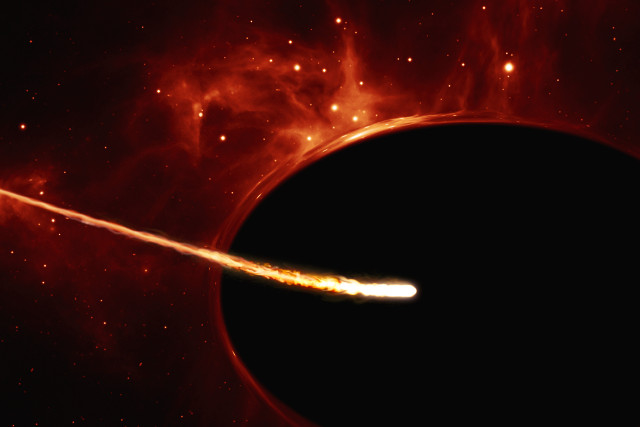
Artistic concept of a star getting close to a supermassive black hole (Image ESO, ESA/Hubble, M. Kornmesser)

An article published in the journal “Nature Astronomy” describes a research about ASASSN-15lh, which had been classified as a superluminous supernova after it was discovered in 2015. An international team led by Giorgos Leloudas of the Weizmann Institute of Science, Israel, and the Dark Cosmology Centre, Denmark, examined the observations made with various telescopes and concluded that it was actually a star destroyed by a supermassive black hole.

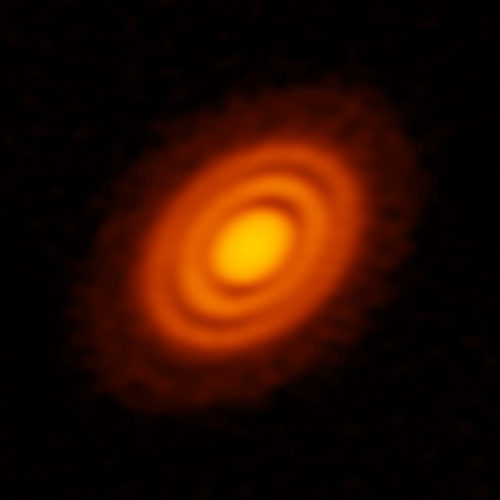
The HD 163296 system (Image ALMA (ESO/NAOJ/NRAO); A. Isella; B. Saxton (NRAO/AUI/NSF))

An article published in the journal “Physical Review Letters” describes the evidence of the presence of two newborn planets in the HD 163296 star system. A team of astronomers led by Andrea Isella of the Rice University in Houston used the ALMA radio telescope to study two major gaps that have left a mark in both the dust and in gas portion of the protoplanetary disk surrounding the star.

The HTV-6 cargo spacecraft capture by the International Space Station's robotic arm (Image NASA TV)

A little while ago the HTV-6 “Kounotori” spacecraft has been captured by the robotic arm Canadarm2 on the International Space Station, operated by Shane Kimbrough with the assistance of Thomas Pesquet. The Japanese space cargo ship, which blasted off last Friday, carries a huge amount of supplies and experiments. After its capture, it will take a little while before the HTV-6 starts getting moved to its berthing location on the Harmony module.

Artistic representation of millisecond pulsar deforming its compaion star (Image NASA)

An article published in “The Astrophysical Journal” describes a study of a binary system consisting of a millisecond pulsar known as PSR J1723-2837 and a small common star. Astrophysicist John Antoniadis of the University of Toronto and the amateur astronomer AndrĂ© van Staden discovered for the first time starspots and a powerful magnetic field in a millisecond pulsar’s companion. It’s a research that can help better understand this type of pulsar’s behavior.

The HTV-6 cargo spacecraft blasting off atop a H-IIB rocket (Image NASA TV / JAXA)

A little while ago the HTV-6 spacecraft blasted off atop a H-IIB rocket from the Tanegashima space center in Japan for a resupply mission to the International Space Station. About fifteen minutes after the launch, the cargo spacecraft separated regularly from the rocket’s last stage, entered its preliminary orbit and deployed its solar panels and navigation antennas.