The supernova remnants RCW103 with the magnetar 1E 1613 at its center (Image X-ray: NASA/CXC/University of Amsterdam/N.Rea et al; Optical: DSS)

Two articles, one published in “The Astrophysical Journal Letters” and one published in the journal “Monthly Notices of the Royal Astronomical Society”, describe as many research on the supernova remnants known as RCW103. At its center a neutron star formed called 1E 161348-5055 – or simply 1E 1613 – that has been puzzling astronomers for decades for its abnormal behavior. Now two teams independently offered the same explanation: the neutron star has the characteristics of a magnetar.

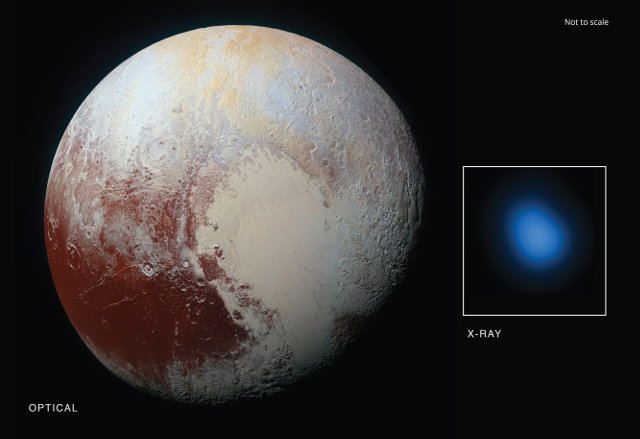
Pluto seen at visible light and at X-rays (not in scale) (Image X-ray: NASA/CXC/JHUAPL/R.McNutt et al; Optical: NASA/JHUAPL)

Two new research are connected in different ways to emissions coming from the dwarf planet Pluto. An article published in the journal “Icarus” describes a research which, through the use of the NASA’s Chandra X-ray Observatory, detected X-rays emissions from Pluto. Another article published in the journal “Nature” offers an explanation for the reddish color to Charon’s poles, caused by methane ripped from Pluto’s atmosphere and turned into ice by the low temperatures.

Tiangong-2 after blasting off atop a Long March 2F T2 rocket (Image courtesy CCTV)

A little while ago the Chinese space laboratory Tiangong-2 (Heavenly Palace 2) was launched from the Jiuquan base atop a Long March 2F T2 rocket. After about 10 minutes it successfully separated from the rocket’s last stage, deployed its solar panels and was place in a temporary orbit. Over the next few days, its thrusters will be used to adjust the orbit to an altitude of about 393 kilometers (238 miles).

The globular cluster Terzan 5 seen by the MAD on the VLT (Image ESO/F. Ferraro)

An article published in “The Astrophysical Journal” describes a research on the globular cluster Terzan 5. An international team of astronomers led by Francesco Ferraro from the University of Bologna discovered that the stars of Terzan 5 are divided into two groups, one with an age of 12 billion years and one with an age of around 4.5 billion years, more or less like the Sun. This unique feature can help to better understand the evolution of the Milky Way.