
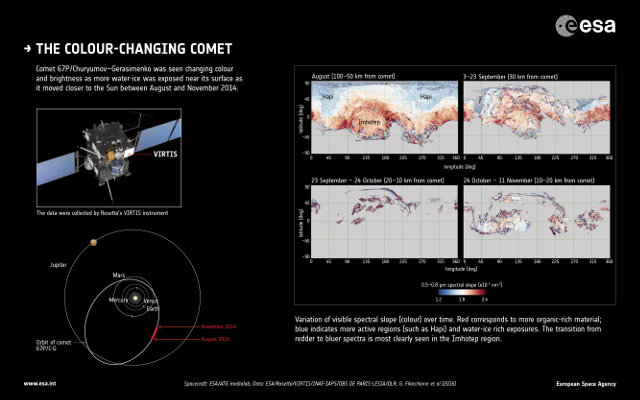
The colors changing on the surface of the comet 67P/Churyumov-Gerasimenko (Image ESA/ATG medialab; Data: ESA/Rosetta/VIRTIS/INAF-IAPS/OBS DE PARIS-LESIA/DLR; G. Filacchione et al (2016))

An article published in the journal “Icarus” describes the change in colors and brightness found on the surface of the comet 67P/Churyumov-Gerasimenko by ESA’s Rosetta space probe. These are the first findings of a study and concern the months immediately following Rosetta’s arrival in the comet’s orbit, in August 2014.

Stephen Hawking and his daughter Lucy in 2008 at NASA's 50th anniversary (Image NASA/Paul Alers)

Yesterday, at a press conference, the Russian entrepreneur Yuri Milner officially announced the Starshot project that aims to build interstellar probes. The idea is to create tiny probes with a sail driven by a laser operated from Earth so they can reach 20% of the speed of light to reach the Alpha Centauri system in just over two decades. The physicist Stephen Hawking and Facebook creator Mark Zuckerberg support the project.

Artistic illustration of the Kepler Space Telescope (Image NASA)

NASA announced that it succeeded in restoring the Kepler space telescope after a few days it entered Emergency Mode. The mission’s engineers restored the communications during the last Sunday but the time table to resume its work is still to be determined. Communications also made it possible to start downloading telemetry and event data to determine the causes of the emergency.

The Dragon spacecraft captured by the International Space Station's robotic arm (Image NAAS TV)

A little while ago the SpaceX Dragon spacecraft was captured by the robotic arm Canadarm2 on the International Space Station. Tim Peake, assisted by his fellow astronaut Jeff Williams, managed the operation and started moving the Dragon to the berthing point at the Harmony module. The spacecraft was launched last Friday and arrived a little more than 20 minutes later than scheduled because it was slowed down by atmosphere drag but eventually the first leg of its mission was accomplished.

SpaceX Dragon cargo spacecraft blasting off atop a Falcon 9 rocket in the CRS-8 mission (Image NASA TV)

A few hours ago SpaceX Dragon spacecraft blasted off on a Falcon 9 rocket from Cape Canaveral in its CRS-8 (Cargo Resupply Service) mission, also referred to as SPX-8. After about twelve minutes it successfully separated from the rocket’s last stage and went en route. This is the 8th of 12 missions that include sending the Dragon spacecraft to the International Space Station with various cargoes and then return to Earth, again with various cargoes.