Map of voids and galaxy superclusters around the Milky Way (Image Richard Powell)

An article published in the journal “Astronomy & Astrophysics” describes the discovery of what was called the BOSS Great Wall, a supercluster more than a billion light years long and between 4.5 and 6.4 billion light years from the Earth. With an estimated mass of 10,000 times that of the Milky Way, it’s the largest supercluster discovered so far.

An article published in “The Astrophysical Journal Letters” describes an analysis conducted on data collected by ESA’s Rosetta space probe’s ROSINA instrument that allowed to established that the ice on the comet 67P/Churyumov-Gerasimenko has a crystalline form. It may seem a trivial problem, however such nature implies that it originated in the protosolar nebula and is as old as the solar system.

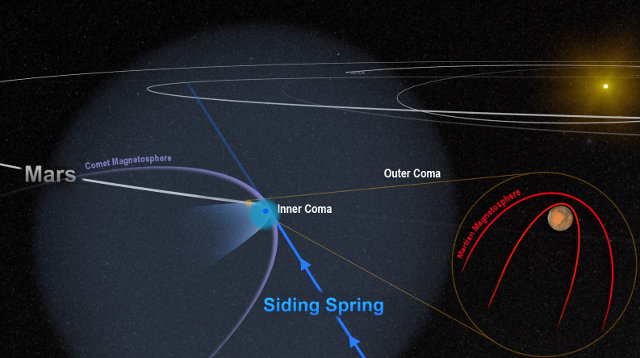
Scheme of the comet C/2013 A1 Siding Spring passing near Mars (Image NASA/Goddard)

An article published in the journal “Geophysical Research Letters” describes the effects on the planet Mars’ magnetic field caused by the close passage of the comet C/2013 A1 Siding Spring in October 2014. Using data collected in that period by NASA’s MAVEN space probe it was possible to reconstruct the moments that were chaotic for the Martian magnetosphere with profound consequences even if temporary.

The area around Ahuna Mons on Ceres photographed by the Dawn space probe (Image NASA/JPL-Caltech/UCLA/MPS/DLR/IDA)

Between March 6 and 7, 2015, depending on your time zone on Earth, NASA’s Dawn space probe entered the orbit of the dwarf planet Ceres. In December 2015 it went down to a lower altitude to conduct a mapping with the best definition and in February 2016 its orbital path led it into a position where it could take excellent pictures of Ahuna Mons, as they called the mountain that used to look like a pyramid and is one of the most curious geological features on Ceres.