
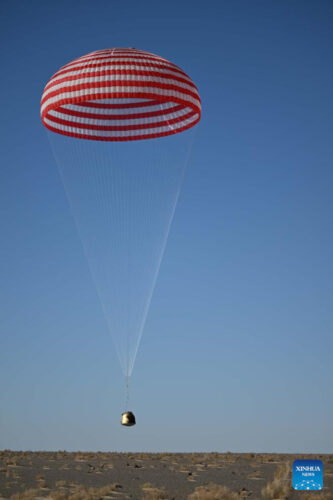
The Shenzhou 17 mission capsule landing (Photo courtesy Xinhua/Lian Zhen)

Yesterday, the three Chinese taikonauts of the Shenzhou 17 mission returned to Earth after spending a little more than six months on the Chinese space station Tiangong. The three taikonauts Jiang Xinlin, Tang Hongbo, and Tang Shengjie had left the station about nine hours earlier to land at a site called Dongfeng in China’s Inner Mongolia Autonomous Region. It’s a procedure that significantly reduces the time to return to Earth and now has become routine.

The Dragon cargo spacecraft departing the International Space Station to end its CRS-30 mission (Image NASA TV)

A few hours ago, SpaceX’s Dragon spacecraft ended its CRS-30 (Cargo Resupply Service 30) mission for NASA splashing down smoothly off the Florida Coast. The Dragon left the International Space Station a little more than 36 hours earlier. For SpaceX, this was the 10th mission of the 2nd contract with NASA to transport supplies to the Station with the new version of the Dragon cargo spacecraft.

Shortly after the splashdown, SpaceX’s recovery ship went to retrieve the Dragon to transport it to the coast. The cargo brought back to Earth will be delivered to NASA within a few hours. The Dragon spacecraft reached the International Space Station on March 23, 2024.

The Shenzhou 18 mission blasting off atop a Long March-2F rocket (Photo courtesy Xinhua/Li Gang)

A confirmation has arrived that three Chinese taikonauts from the Shenzhou 18 mission reached the Chinese space station Tiangong with an automated docking maneuver. They blasted off about 6.5 hours earlier atop a Long March-2F rocket from the Jiuquan Satellite Launch Center. They form the 7th crew of the Chinese space station and will remain there for about six months, the standard duration for a mission.

The three taikonauts, as the Chinese call their astronauts, of the Shenzhou 18 mission are Ye Guangfu, Li Cong, and Li Guangsu.

A spectroscopic observation conducted with the James Webb Space Telescope's Near Infrared Spectrograph (NIRSpec) instrument of the galaxy Cosmos-11142 centered on the oxygen emission line doubly ionized

An article published in the journal “Nature” reports the observation of very strong winds coming from the supermassive black hole at the center of the galaxy Cosmos-11142 which inhibited star formation within it. A team of researchers led by Professor Sirio Belli of the University of Bologna, Italy, used the James Webb Space Telescope to detect the movement of cold neutral gas pushed at such a speed that it swept away the gas in the galaxy and thus prevented the formation of new stars. This is the first evidence of how a supermassive black hole can have that effect on a galaxy.

Io as seen by the Juno space probe (Image NASA/JPL-Caltech/SwRI/MSSS. Image processing: Gerald Eichstädt/Thomas Thomopoulos (CC BY))

At the European Geophysical Union General Assembly held in Vienna last week, NASA’s Juno mission principal investigator Scott Bolton illustrated some new discoveries offered by the Juno space probe, including some regarding Io, Jupiter’s volcano-covered moon. Io was also studied by a team of researchers who used the ALMA radio telescope to map the movements of sulfur isotopes and reconstruct the tidal heating that generates the intense volcanic activity. The results were published in an article in the journal “Journal of Geophysical Research: Planets”.