
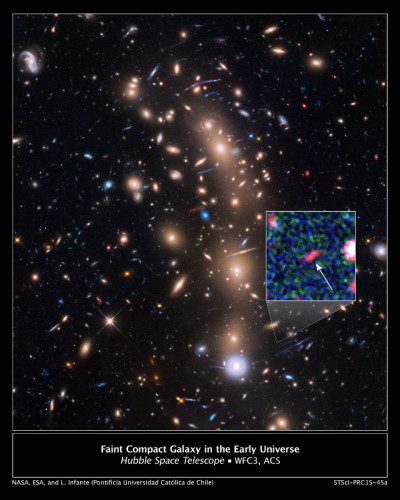
The galaxy cluster MACSJ0416.1-2403 observed by the Hubble Space Telescope with the galaxy nicknamed Tayna in the inset (Image NASA, ESA, and L. Infante (Pontificia Universidad Catolica de Chile))

An article published in the journal “Astrophysical Journal” describes the discovery of the faintest galaxy in the early universe. According to this study, this galaxy was born when the universe was “only” about 400 million years old and for this reason was nicknamed Tayna, which means “first born” in the Aymara language. To detect its light the gravitational lensing effect of a galaxy cluster was used. That allowed to capture the extremely dim light of a total of 22 ancient galaxies using the Hubble and Spitzer space telescopes.

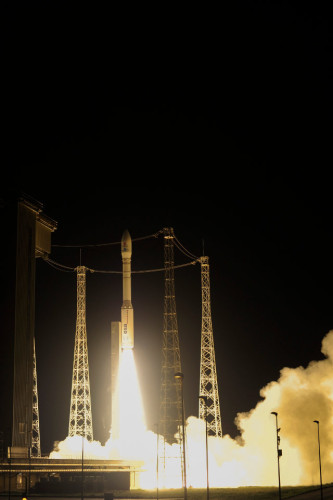
The LISA Pathfinder space probe blasting off atop a Vega rocket (Photo ESA–Stephane Corvaja)

A few hours ago ESA’s LISA Pathfinder space probe was successfully launched atop a Vega rocket from the Kourou space center in French Guiana. After about an hour and 45 minutes it separated from the rocket’s upper stage and activated to begin its long journey thanks to its propulsion module.

LISA Pathfinder entered an elliptical orbit where it will make a series of maneuvers that within a few weeks will take it to the area called L1, where the gravity of the Earth and the Sun get balanced with the other forces acting on the probe. The propulsion module will be disconnected after exhausting its function and the probe will remain in the L1 area, about 1.5 million kilometers (about 900,000 miles) from Earth.

The Orions spacecraft's service module built by ESA moved in the USA (Photo NASA)

NASA provided some new information about the first flight test for its Space Launch System (SLS) with the Orion spacecraft, called Exploration Mission-1 (EM-1). The agency did it in the occasion of the arrival to the Space Power Facility (SPF) in Sandusky, Ohio, of the test version of the Orion’s service module built by ESA known as European Service Module (ESM). This will allow NASA to begin testing the new spacecraft in its full configuration, a crucial step in the preparation of the EM-1 mission.

Artistic illustration of the event ASASSN-14li with the accretion disk around the black hole and part of the materials from the shredded star forming a tail (Image Spectrum: NASA/CXC/U.Michigan/J.Miller et al.; Illustration: NASA/CXC/M.Weiss)

An article published in the journal “Science” describes the observations of a supermassive black hole with a mass a few millions times that of the Sun that destroyed a star with the consequent formation of a jet of matter moving at speeds close to that of light. This event, called ASASSN-14li, had already been described a few weeks ago in another study whose results were published in the journal “Nature”.

Image of the star VY Canis Majoris captured by the SPHERE instrument on VLT (Photo ESO)

An article published in the journal “Astronomy & Astrophysics” describes a study on the star VY Canis Majoris, one of the largest in the Milky Way. The SPHERE instrument installed on ESO’s VLT (Very Large Telescope) allowed to obtain very detailed images of this star making it possible to study the dust that surrounds it and the considerable mass it loses in time ejecting it.