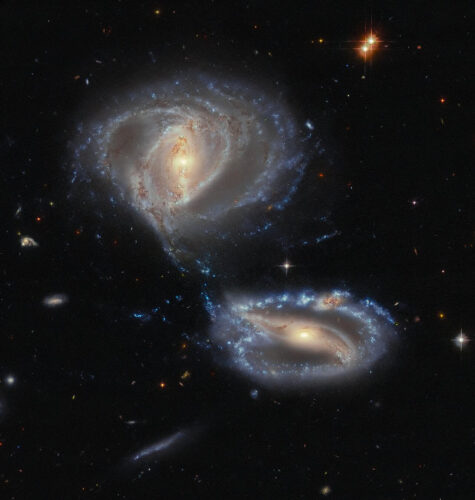
Arp-Madore 2339-661 (Image ESA/Hubble & NASA, J. Dalcanton, Dark Energy Survey/DOE/FNAL/NOIRLab/NSF/AURA Acknowledgement: L. Shatz)

An image captured by the Hubble Space Telescope depicts Arp-Madore 2339-661, an object that until not many years ago was considered a pair of interacting galaxies, cataloged as NGC 7733 (bottom right) and NGC 7734 (top left). However, observing the upper arm of NGC 7733, it’s possible to see a sort of large knot of a color different from the predominant blue which is actually a dwarf galaxy, now cataloged as NGC 7733N. The consequence is that the interaction taking place is what some call a merging group. Mergers between two galaxies are normal but sometimes there are more galaxies and in this case, there are three of them that show signs of having active galactic nuclei.

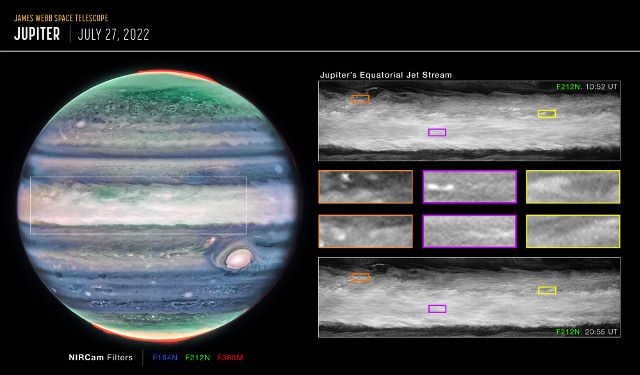
Jupiter in an observation with the NIRCam instrument and in the insets some progressive zooms showing various wind shears at altitudes between 20 and 35 kilometers above in Jupiter's clouds

An article published in the journal “Nature Astronomy” reports the discovery of an equatorial jet stream traveling at over 500 kilometers per hour in the lower layers of the stratosphere of the planet Jupiter extending for almost 5,000 kilometers. A team of researchers analyzed data collected by the James Webb Space Telescope’s NIRCam (Near-Infrared Camera) instrument during observations conducted in July 2022 to obtain details of the winds that include so-called wind shears, sudden variations in intensity and direction with altitude or distance. Data collected with the Hubble Space Telescope provided additional information about the atmosphere of Jupiter’s equator and other phenomena in that area useful in determining the characteristics of the jet stream.

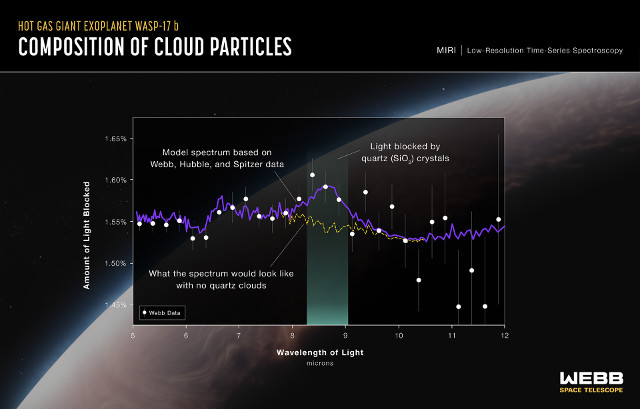
Transmission spectroscopy of the exoplanet WASP-17 b

An article published in “The Astrophysical Journal Letters” reports a study of the exoplanet WASP-17 b that includes the detection of quartz in this hot Jupiter’s atmosphere. A team of researchers used the James Webb Space Telescope to detect the subtle effects of quartz crystals, nanoparticles dispersed in the very hot atmosphere of WASP-17 b, which received the official name Ditsö̀ in early 2020.

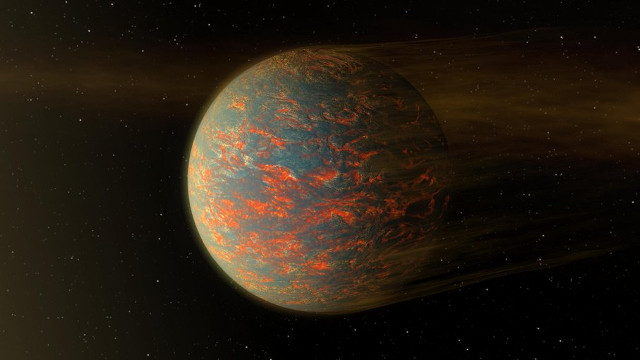
Artistic concept of a lava world (Image NASA/JPL-Caltech)

An article published in “The Astrophysical Journal” reports a study on so-called lava worlds, rocky exoplanets so close to their stars that at least a part of their surface is made up of molten rock. A team of researchers coordinated by the Ohio State University conducted computer simulations with the free / open source software ExoPlex to try to understand the evolution of these truly exotic planets, concluding that in certain cases, it’s possible that significant quantities of chemicals necessary for life remain trapped in their mantle. It remains unlikely, to say the least, that life forms could develop in those conditions, but if a planet of that type were to cool, the situation would change considerably. In any case, it’s important to understand its evolution because there may be many lava worlds that offer the possibility of studying a molten planetary mantle.

The Psyche space probe blasting off atop a Falcon Heavy rocket (Image NASA TV)

A little while ago, NASA’s Psyche space probe blasted off atop a SpaceX Falcon Heavy rocket from the Kennedy Space Center. After just over an hour, it successfully separated from the rocket’s last stage and set off on its route that will take it into deep space, towards asteroid 16 Psyche, which it will reach towards the end of July 2029 to study its structure composed mainly of iron-nickel.

Within the asteroid belt between Mars and Jupiter and right now about 3.6 billion kilometers away from Earth, asteroid 16 Psyche is one of the largest known. It’s an M-type asteroid, the type with the highest metal content. It has an irregular shape with a maximum length of almost 280 kilometers, which brings it close to the size of a dwarf planet.